Friday, April 1, 2022

Obscusion B-Side: Hong Kong '97 vs. Hong Kong 97: The Final Showdown of Ultimate Destiny

The year 2022 will mark the 25th Anniversary of the "Transfer of Sovereignty Over Hong Kong", when the United Kingdom gave control over the island of Hong Kong back to the People's Republic of China, as per the extension agreement made in 1898, when the Qing dynasty was still around; while it's often referred to as "99 years of British rule", the actual full reign was 156 years. If you are hoping for a look into the intricacies of life in Hong Kong during the past quarter century & how China has treated the island & its populace ever since, then I must apologize. Besides, I'm sure there will be people doing just that when the actual anniversary of the transfer comes to pass on July 1. However, this was a very notable moment in world history, so naturally there were a variety of movies, books, & stories that based themselves around this moment, to some extent. Some, like 2014's The Midnight After, looked at things from the perspective of those living in Hong Kong itself, while others, like Rush Hour, Chinese Box, & James Bond novel Zero Minus Ten, make the handover itself a notable part of their plots.

However, two productions (a movie & a video game) made the then-future 1997 transfer of Hong Kong from Britain to China the focus of their actual titles! I mean... how can I NOT pit them against each other?!


Released straight-to-video on November 9, 1994, Hong Kong '97 was a ~91-minute movie directed by Albert Pyun (Captain America ['90], Cyborg), written by Randall Fontana (who'd reunite with Pyun for 2010's Bulletface), & starred Robert Patrick, Ming-Na Wen, Brion James, & Tim Thomerson. It went on to receive a mixed reception & more or less would be forgotten with time after Trimark Pictures (Warlock, Leprechaun) released it on VHS & laserdisc; it's since never seen an official re-release of any sort. The following year then saw something of almost exactly the same name see unofficial release in Japan... barely. Released whenever-the-hell in 1995, Hong Kong 97 (note the lack of an apostrophe, because that is essential in differentiating between the two), or "HONGKONG 1997" on the cover, was produced by Happy Software Ltd., or HappySoft for short. This was a company based out of Shinjuku & run by Yoshihisa "Kowloon" Kurosawa, a notorious Japanese writer who has made a small name for himself in certain circles for traveling to various "underground" regions within Pacific Asia & writing travel journals about all of the seedy, illegal, & just messed up stuff he saw. Kurosawa, however, was also a fan of video games, and would hire people he knew to program satirical & cheap PC games for unofficial release, like a strategy game that parodied Aleph (formerly Aum Shinrikyo). After finding out about various backup devices that can rip video game cartridges to 3.5" floppy disks, Kurosawa decided that he'd give releasing a game for the Super Famicom a try.

So, after hiring a programmer friend who worked at Enix to help him, Hong Kong 97 was completed in just two days, and after hiring someone else to translate the on-screen text (so the player can choose between Japanese, traditional Chinese, & English), he sold the game via mail order for ~$20 (or $37.23, in 2022), allegedly on both floppy disk & cartridge (though no one can confirm the latter)… and Kurosawa wound up selling around 30 copies, before simply forgetting that he ever made it. However, unlike Albert Pyun's movie, Kowloon Kurosawa's game would eventually find itself notoriety online during the 00s, as someone wound up ripping the rom & distributed it online. Then, in 2015, YouTube video pioneer James Rolfe covered Hong Kong 97 as Episode 134 of Angry Video Game Nerd, during which Rolfe also brought up Pyun's movie, due to their nearly-matching titles; Rolfe's video has since been viewed over 9.7 million times. Later, much smaller channel Ultra Healthy Video Game Nerd wound up getting hold of the floppy disk release itself in 2018 & even did an in-person interview with Kurosawa himself in 2020 (following Kurosawa's 2018 interview with the South China Morning Post), and today the full story of Hong Kong 97 is readily available for anyone to find out.

However, one question remains left to be answered:
WHICH HONG KONG (')97 IS BETTER?!?!?!?!?!?!

Monday, March 21, 2022

Obscusion B-Side: Flash Traffic: City of Angels: That Entire Title is an Oxymoron

In 1991, Edmond Heinbockel left his job as CFO for PC adventure game maestro Sierra On-Line to form his own studio, Tsunami Games (a.k.a. Tsunami Media), in the same exact city of Oakhurst, California. At first, Tsunami's focus was primarily on making PC adventure games, just like Sierra, but these initial efforts didn't look to do so well critically, though I guess sales were good enough for the company to stay around. In fact, in 1996, Issue #148 of Computer Gaming World even named two of Tsunami's games, 1993's Ringworld: Revenge of the Patriarch (based on Larry Niven's iconic sci-fi novels) & Blue Force (designed by Police Quest's Jim Walls), two of the 50 worst computer games of all time, slotting in at #14 & #37, respectively; ouch. In late 1994, though, Tsunami released something different from anything it had developed before, so much so that it wasn't even published by the company itself, but rather saw Time Warner Interactive (formerly Tengen) sign on to handle that part of the equation.

Of course, this was also for PCs in the mid-90s, using this tech called the "CD-ROM" that had only recently caught on due to the massive success of the game Myst...

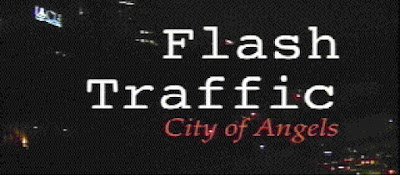
Well, they certainly didn't break the budget for the title card...
Nothing screams "Just like a movie!" quite like Mechanical Extended.

Making its debut at COMDEX in November of 1994, Flash Traffic: City of Angels is an "interactive movie", i.e. an FMV game where you primarily watch full-motion video footage play out until you arrive at a point where you can respond to the scene via various choices. Despite Windows 3.1 being around & supported by many PC games of the time, Flash Traffic requires MS-DOS to boot, so today the game needs a workaround to be playable on modern hardware, like the emulator DOSBox. However, due to Tsunami Games going out of business in the late 90s, it's unknown when exactly, the game isn't something that you can just go to Steam or GOG & purchase in a ready-made form. Luckily, a person going by the name "White Bob" went through the trouble of making a custom installer that's compatible on Windows 7 through 10, and even uploaded it to Archive.org back in November of 2020. Considering the status of the developer, this would constitute being "abandonware", a type of orphan work; the legality of this, of course, is dubious, at best. However, I should point out that this only reflects the original version of Flash Traffic, not the later "RealMagic Interactive MPEG Version" (which features better quality & proper full-screen video), as that release is only playable on period-accurate computers, due to its reliance on a specific range of MPEG playback boards that Sigma Designs released in the mid-90s & naturally aren't compatible with modern-day computers.

Why am I bothering to do a review for a forgotten interactive movie from a failed game studio? Honestly, it's simply because Flash Traffic has remained in my mind ever since I first saw it as a young child on an early PC Gamer Demo Disc from the time (I think it was the Vol. 2 disc, which was the first demo disc I ever experienced), and now I finally want to see it in full for myself, so I figured "Hey, why not gather my thoughts together here, & share it online?"; also, this kind of thing fits Obscusion B-Side perfectly.

Wednesday, March 9, 2022

Demo Disc Vol. 20: Korean Kwan

Born on July 4, 1972 in Busan, South Korea, Park Sung-Woo (or Sung-Woo Park, if you prefer Western order) majored in art at Dong-A University before dropping out & joining a manhwa club that made fantasy comics for gaming magazine Gemtong. Park would make his official debut in manhwa in 1993 when he started Legend of the 8 Dragon Gods (or "Dark Striker", in some circles) in the pages of IQ Jump, the first weekly serialized manhwa magazine, where it apparently became a bit of a leader in fantasy storytelling in the country, slightly predating a fantasy novel boom that Korea would later have. Park would have to put that series on hold after six volumes, due to his mandatory military service, but afterwards returned with Legend of the 8 Dragon Gods PLUS, a sequel that ran in a different magazine & took place 150 years later; the original series would then be given the subtitle "Classic", to differentiate itself. Unfortunately, due to a mix of lost manuscripts & a publisher shake-up, PLUS was left unfinished after 19 volumes. However, around the same time Park debuted the sequel to his first professional work (which he made alongside his CLAMP-esque artist collective, Studio Zero), he also debuted a new series in IQ Jump in 1997, Chun Rhang Yhur Jhun/The Heated Biography of Sirius, a historical fiction manhwa with a focus on martial arts action. It would run until April of 2000 for 13 volumes & become a very celebrated series in South Korea, even receiving a strategy RPG adaptation for Windows PCs in 2001 that took 3 CDs to contain.

Though I read the official English release for this Demo Disc, I'll be sourcing
from an old scanlation for images. You use what you can find, sometimes.

In late 2005, English publisher Infinity Studios would license & release Chun Rhang Yhur Jhun under its original Korean title, despite the press release also using an alternate (& much friendlier) English title of "Sirius Wars", though this would be based on the 10-volume re-release that came out in 2003. In the end, Infinity Studios would only ever release the first five volumes physically between April of 2006 & January of 2008, though the publisher may have also released Volumes 6 & 7 digitally later in 2008. However, these were literally PDFs that were shipped to buyers on burned CDs, so it's nigh-impossible to verify today if they actually happened. So, in the very first manhwa edition of Demo Disc, with five physical books on hand, how is the first half of Chun Rhang Yhur Jhun, and does it truly deserve the seemingly venerated status it has in South Korea?

It's around 666-667 AD, and the Kingdom of Goguryeo is at war with the unified forces of Silla & China's Tang Dynatsy. In the midst of this war, a young practitioner of the martial art Sa Shin Mu (literally "Martial Arts of the God of Death") named O'Rhang Yhun has been ordered by his master Gyu-Yhum to enter China & deliver a letter to his eldest "hyung/brother-in-training", Pa Goon Sung, only to be attacked & left for dead by his second eldest hyung, Ghyur-Mahro, as a traitor to Goguryeo. O'Rhang is rescued by a woman named Ha-Rhang Whur & left to recover in a refugee village, which is quickly attacked by the Jook-Rhim-O-Gwe/The Bamboo Grove Fivesome, a group of bandits lead by five siblings. However, through a case of mistaken thievery, the letter for Pa Goon Sung is stolen by the Chung-Sue-Moon/Gates of Blue Water, a clan which once had great power within the prior Sui Dynasty & has a past with Gyu-Yhum. Now O'Rhang journeys alongside his female compatriots Ha-Rhang & Dahn-Ryoung (the youngest & sole[?] survivor of the Jook-Rhim-O-Gwe, after a Chung-Sue-Moon ambush), as each of them have their own reasons to go after the Chung-Sue-Moon & its leader, Jung-Woong Suk.

Monday, February 28, 2022

"But It Was Cancelled!": The Short-Run Jump Manga That Deserve English Release

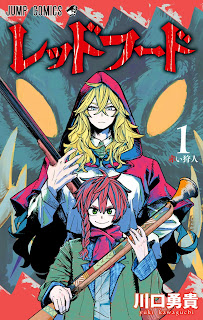
Two weeks ago, Viz Media made a variety of new manga release announcements on Twitter, both for physical & digital-only. One that was interesting in both the announcement itself & the reaction to it was that The Hunters Guild: Red Hood by Yuki Kawaguchi would be receiving a physical release starting in the Fall. What makes this announcement interesting is the fact that Red Hood only ran for a scant 18 chapters in Weekly Shonen Jump throughout late 2021 (not including the original one-shot), and will only total three volumes in length. However, while Red Hood seemingly failed to find an audience in its own home country of Japan, it looked to have found a bit of a rabid cult following with English-speaking readers, due to its initial simulpublishing. Viz looks to feel that Red Hood's fandom was enough to give the manga a physical release in North America, despite it getting canned quickly in Japan.

However, if you look at the responses to that announcement tweet, you'll also see a decent amount of people questioning the decision to give Red Hood this treatment. Aside from those who simply would have preferred other titles instead, a common complaint basically boils down to this thought: "But It Was Cancelled! Why Would Anyone Want to Buy a Cancelled Manga?".

(Also, please don't go sassing companies about the stuff they choose to release to the point of the publisher actually calling you out on such behavior. That's just messed up.)


Every single manga magazine has its own history of cancelled series, but there might not be one as notoriously cutthroat as Weekly Shonen Jump. On the one hand, one can argue that Shueisha's infamously strict cut-off point does result in (for the most part) only the strongest overall manga being allowed to survive or even thrive in Jump, which in turn helps create a long history of extremely strong and/or memorable titles. On the other hand, almost anyone who's followed Jump manga for any length of time can name at least a couple of series that they feel were unfairly cut short way too early & weren't allowed to truly live up to their potential, and there have been very few that were allowed second chances in some way (Rising ImpactHareluya [II BØY], iShojo[+], Otoko Zaka [which took ~30 years to happen!], etc.). However, I'd argue that there is still merit in reading these kinds of short-run manga, & in turn there's value in manga publishers licensing these series for release outside of Japan.

In particular, I'd like to focus mostly on short-lived manga by successful mangaka, whether they came before their respective hit series, or if they were what had to follow-up what they're most iconic for, and since this piece was inspired by a Jump manga, let's focus on that magazine for now. We'll be splitting this up across five decades, so let's start at the most logical spot: The Beginning.

Monday, February 14, 2022

Hatsukoi Limited: They'd Do Anything For Love (But They Won't Do That)

In the 11+ years of doing The Land of Obscusion, I have never once written something for Valentine's Day, at least not intentionally so. A big part of that simply comes down to the fact that this day has no real relevance to me, as I'm possibly what one might call a hapless/hopeless romantic. As of this piece I have no girlfriend or paramour, & I've never even been on a date (hence the "hapless/hopeless" moniker), but I definitely have an appreciation for the concept of love. When at its purest it seems like the greatest feeling one can have, to just know that there's someone out there that cares so deeply about you the same way you care about them. But enough romanticizing about romance, let's finally celebrate Valentine's Day on this blog properly with a review for an anime that's all about that early stage of ardent adulation & appreciation: "First Love".


While not exactly the magazine's forte, there have been numerous manga about love & romance in the history of Weekly Shonen Jump. However, they almost exclusively focus on seeing things primarily though the lens of a male perspective, which isn't exactly surprising, since the magazine is mainly intended to be read by young males, ideally in their early teens, i.e. when puberty starts to hit & those initial feelings towards others start to bloom ("traditionally", of course). Also not surprising is that most manga in Jump are done by men, which makes the creator of our subject here a unique outlier. Originally debuting in the 90s under the pen name Mikan Momokuri (used solely for shojo titles), Mizuki Kawashita made her debut with Shonen Jump in 2000 with the short-lived Lilim Kiss, before hitting it (relatively) big in 2002 with Strawberry 100%, a romantic harem comedy series that would run until 2005 & last 19 volumes, becoming possibly the longest-running romance manga in Jump history for about a good decade, until the likes of Yuuna & the Haunted Springs and We Never Learn debuted in the mid-2010s.

Kawashita would follow up Strawberry 100% with late 2007's Hatsukoi/First Love Limited, which flipped the script for a Jump romance manga & showed things from the perspective of young ladies. In the end, Hatsukoi Limited would only last four volumes & end in early 2008 after 32 chapters (still Kawashita's second longest series in Jump), yet managed to find itself a post-manga life, somewhat. In the Spring of 2009, following both a drama CD & light novel adaptation, a 12-episode anime adaptation aired as a part of satellite network BS-11's ANIME+ late-night time slot. While the anime initially missed being simulcasted in any way, as this aired right as that was only really starting to become a thing, it would later get licensed by Sentai Filmworks, which released a sub-only DVD boxset in July of 2012, & it is still currently streaming over at Hidive, while the DVD boxset is apparently now out of print & actually getting expensive. So let's honor Saint Valentine himself by taking a look at how the concept of "First Love" affects the minds of young ladies (& "gentlemen"), as originally explained by a lady herself!