Monday, February 28, 2022

"But It Was Cancelled!": The Short-Run Jump Manga That Deserve English Release

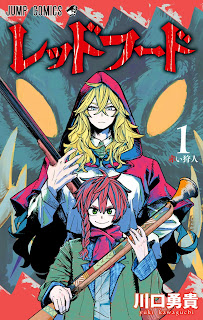
Two weeks ago, Viz Media made a variety of new manga release announcements on Twitter, both for physical & digital-only. One that was interesting in both the announcement itself & the reaction to it was that The Hunters Guild: Red Hood by Yuki Kawaguchi would be receiving a physical release starting in the Fall. What makes this announcement interesting is the fact that Red Hood only ran for a scant 18 chapters in Weekly Shonen Jump throughout late 2021 (not including the original one-shot), and will only total three volumes in length. However, while Red Hood seemingly failed to find an audience in its own home country of Japan, it looked to have found a bit of a rabid cult following with English-speaking readers, due to its initial simulpublishing. Viz looks to feel that Red Hood's fandom was enough to give the manga a physical release in North America, despite it getting canned quickly in Japan.

However, if you look at the responses to that announcement tweet, you'll also see a decent amount of people questioning the decision to give Red Hood this treatment. Aside from those who simply would have preferred other titles instead, a common complaint basically boils down to this thought: "But It Was Cancelled! Why Would Anyone Want to Buy a Cancelled Manga?".

(Also, please don't go sassing companies about the stuff they choose to release to the point of the publisher actually calling you out on such behavior. That's just messed up.)

Every single manga magazine has its own history of cancelled series, but there might not be one as notoriously cutthroat as Weekly Shonen Jump. On the one hand, one can argue that Shueisha's infamously strict cut-off point does result in (for the most part) only the strongest overall manga being allowed to survive or even thrive in Jump, which in turn helps create a long history of extremely strong and/or memorable titles. On the other hand, almost anyone who's followed Jump manga for any length of time can name at least a couple of series that they feel were unfairly cut short way too early & weren't allowed to truly live up to their potential, and there have been very few that were allowed second chances in some way (Rising Impact, Hareluya [II BØY], iShojo[+], Otoko Zaka [which took ~30 years to happen!], etc.). However, I'd argue that there is still merit in reading these kinds of short-run manga, & in turn there's value in manga publishers licensing these series for release outside of Japan.

In particular, I'd like to focus mostly on short-lived manga by successful mangaka, whether they came before their respective hit series, or if they were what had to follow-up what they're most iconic for, and since this piece was inspired by a Jump manga, let's focus on that magazine for now. We'll be splitting this up across five decades, so let's start at the most logical spot: The Beginning.

Monday, February 14, 2022

Hatsukoi Limited: They'd Do Anything For Love (But They Won't Do That)

In the 11+ years of doing The Land of Obscusion, I have never once written something for Valentine's Day, at least not intentionally so. A big part of that simply comes down to the fact that this day has no real relevance to me, as I'm possibly what one might call a hapless/hopeless romantic. As of this piece I have no girlfriend or paramour, & I've never even been on a date (hence the "hapless/hopeless" moniker), but I definitely have an appreciation for the concept of love. When at its purest it seems like the greatest feeling one can have, to just know that there's someone out there that cares so deeply about you the same way you care about them. But enough romanticizing about romance, let's finally celebrate Valentine's Day on this blog properly with a review for an anime that's all about that early stage of ardent adulation & appreciation: "First Love".


While not exactly the magazine's forte, there have been numerous manga about love & romance in the history of Weekly Shonen Jump. However, they almost exclusively focus on seeing things primarily though the lens of a male perspective, which isn't exactly surprising, since the magazine is mainly intended to be read by young males, ideally in their early teens, i.e. when puberty starts to hit & those initial feelings towards others start to bloom ("traditionally", of course). Also not surprising is that most manga in Jump are done by men, which makes the creator of our subject here a unique outlier. Originally debuting in the 90s under the pen name Mikan Momokuri (used solely for shojo titles), Mizuki Kawashita made her debut with Shonen Jump in 2000 with the short-lived Lilim Kiss, before hitting it (relatively) big in 2002 with Strawberry 100%, a romantic harem comedy series that would run until 2005 & last 19 volumes, becoming possibly the longest-running romance manga in Jump history for about a good decade, until the likes of Yuuna & the Haunted Springs and We Never Learn debuted in the mid-2010s.

Kawashita would follow up Strawberry 100% with late 2007's Hatsukoi/First Love Limited, which flipped the script for a Jump romance manga & showed things from the perspective of young ladies. In the end, Hatsukoi Limited would only last four volumes & end in early 2008 after 32 chapters (still Kawashita's second longest series in Jump), yet managed to find itself a post-manga life, somewhat. In the Spring of 2009, following both a drama CD & light novel adaptation, a 12-episode anime adaptation aired as a part of satellite network BS-11's ANIME+ late-night time slot. While the anime initially missed being simulcasted in any way, as this aired right as that was only really starting to become a thing, it would later get licensed by Sentai Filmworks, which released a sub-only DVD boxset in July of 2012, & it is still currently streaming over at Hidive, while the DVD boxset is apparently now out of print & actually getting expensive. So let's honor Saint Valentine himself by taking a look at how the concept of "First Love" affects the minds of young ladies (& "gentlemen"), as originally explained by a lady herself!

Monday, January 31, 2022

Obscusion B-Side: Prowling the Official Atari Jaguar Catalog: 1994 (Part 2)

"It should really say something that, despite launching nationwide in the US in May, followed by other regions over the next few months, the Atari Jaguar only saw a paltry three new releases over the next six months (plus one more that came out during the test market run)…Still, with actual next-gen competition now coming out in Japan, it's only a matter of time until Atari can no longer rely on marketing talk regarding 'Doing the Math'. Simply put, the games need to deliver."

(The original) Atari's final console was entering its first proper holiday season (i.e. not a test run) come the end of 1994, but prior to November 28 only had a mere eight games to its name, one of which was a pack-in. Luckily, things would change in literally the final 34 days of the year, as nine games would see release by the end of 1994, a little over doubling the Jaguar's total catalog to 17 games. Since we already covered Checkered Flag last time, that leaves eight games left to cover for 1994, so we'll be splitting them up. First up are the remaining two games that came out on November 28, as well as one that released later that same week on December 2, and the first of four games that came out the following week on December 9. Admittedly, the games we've covered so far have honestly been decent-at-worst & outstanding-at-best, for the most part, with only two that I can honestly say are just utter crap (Trevor McFur & Checkered Flag). So what do we have on the docket this time around?

*checks chronological list of Atari Jaguar games*

#$@!%

This game is so boring to look at via stills,
so here's an image from the intro.

Releasing alongside Checkered Flag on November 28, Club Drive is usually credited as having been developed internally at Atari Corporation, but from all accounts was actually developed by a lot of the same staff over at Rebellion Developments who worked on Alien vs. Predator; we won't see a true, 100% Atari-developed Jaguar game for a while still. Club Drive does seem to be a sort of spiritual successor to arcade games Hard Drivin' & Race Drivin' from 1989 & 1990, though those titles were from Atari Games, the other half of the original Atari, Inc. that Atari Corporation also spawned from. It should be noted that, despite having the same overall name & coming from the same overall company, Atari Games & Atari Corporation were two completely different entities with completely different owners come late 1994 (Time Warner & the Tramiel Family, respectively); yes, "Atari" had been an utter mess since the mid-80s. Regardless, I only bring up the Drivin' Series because Club Drive follows in a somewhat similar vein, i.e. a focus on driving a car (primarily from a first-person perspective) in a fully polygonal 3D environment. In terms of gameplay, you're given three modes: Collect, where you're tasked with collecting "Powerballs" as fast as you can (or the first to collect the quota, in multiplayer); Racing, where you have to reach checkpoints in order to fulfill a specific number of laps; & Tag, a multiplayer-only mode in which one player is "it" and the winner must avoid being "it" for the specified amount of time.

I'd argue that none of this really matters, though, because Club Drive is rather terrible... Though shockingly not as bad as I was expecting.

Monday, January 17, 2022

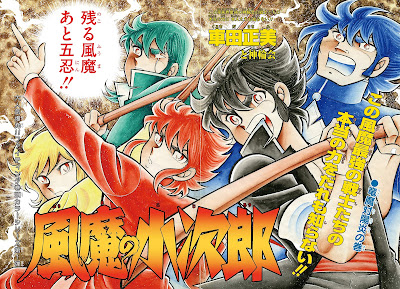
Fuma no Kojirou Trivia Track: Six Neat, Important, or Interesting Factoids

Back at the start of 2017, I celebrated the 40th Anniversary of the debut of Ring ni Kakero, Masami Kurumada's first hit manga, by dedicating all of January to RnK. One of the things I did to celebrate was create a "Trivia Track", i.e. a listicle detailing six factoids regarding RnK that I felt were fun or cool to share. In all honesty, I've occasionally considered bringing back the Trivia Track concept for other anime & manga, but never really went much further than just think about it. It's now been five years since that listicle, and the start of 2022 technically marks the 40th Anniversary of the debut of Masami Kurumada's follow up to Ring ni Kakero... so let's have some fun, shall we?

"They're not actually color-coordinated like that, right?"
"No, they're not, but it sure looks neat."

After the final chapter of Ring ni Kakero was serialized in Issue #44 of Shonen Jump in 1981 in "full-color" (read all about it in the aforementioned Trivia Track), Masami Kurumada took a break in order to get ready for his next series. Eleven issues later, in early 1982, Kurumada returned with the two-part debut of his next serialized manga (his third overall), Fuma no Kojirou/Kojirou of the Fuma. I say "two-part" because FnK's first chapter was technically split up across two issues. First there's the January 10 special, which was a small collection of five one-shots by various artists (including Akira Toriyama's Escape, as well as Outlaw Man, an early Hirohiko Araki story), and in this special issue was a 61-page "prologue" for FnK. The following day, Combined Issue #3-4 featured the "true" first chapter of FnK, which started the issue with full-color opening pages, i.e. "lead color" (plus red-tinted "all-color" for the remaining pages). In fact, FnK's next two chapters would also start their respective issues with lead color status, showing just how venerated Masami Kurumada was at that time, and the same would later be true for Otoko Zaka's first three chapters in 1984; Saint Seiya's debut in 1986, though, would only get lead color for Chapter 1. For the tankouban release, the prologue became the first chapter, while the first serialized chapter would be combined with the second to become the second tankouban chapter; combining serialized chapters into one for the tankouban was a regular thing at the time.

Now, yes, due to how Shonen Jump (& any manga magazine, really) is published, this two-part debut for Fuma no Kojirou technically happened at the very end of 1981, not the start of 1982. However, if we focused that minutely on silly stuff like that, then we'd have no real idea as to when any manga actually began, so screw it! Anyway, think of this whole "two-part debut" factoid as a freebie, because now we truly begin with our first piece of FnK trivia.

Monday, January 10, 2022

The History of Noriyuki Abe, The Man Who Defined Shonen Anime for 20 Years

For most anime fans, the chances are more than decent that they got their start with the medium in some way via an anime adaptation of a popular shonen manga. However, the majority of the most influential "shonen anime" come from a wide variety of different directors, even if they came from the same animation studio. For example, Fist of the North Star was by the late Toyoo Ashida, Dragon Ball had Daisuke Nishio (alongside Minoru Okazaki before DBZ), & Saint Seiya was by Kozo Morishita (1st half) & Kazuhito Kikuchi (2nd half), despite all three coming from Toei Animation. However, there is one anime director who was consistently directing shonen anime at the same studio, and for roughly 20 years would be behind seven different adaptations, some of which would become iconic in not just Japan but also abroad... And yet I bet almost none of you actually know who he is.

I think it's time we finally celebrate Noriyuki Abe, possibly the most prolific shonen anime director you never knew of, despite likely having watched (& loved) something he directed.


Born on July 19, 1961 in Kyoto, Noriyuki Abe would graduate from Waseda University with a degree in Architecture before joining Studio Pierrot in 1986. Abe would make his proper debut in 1988 with Norakuro-kun as a storyboarder & episode director, positions he would continue to fill for the next few years for Heisei Tensai Bakabon, Karakuri Kengo-den Musashi Lord, Ore wa Chokkaku, & Marude Dameo, all for Pierrot, before going freelance in 1990 & working on Honou no Tokyuji: Dodge Danpei for Animation 21 and the original Chibi Maruko-chan anime for Nippon Animation, working on a single episode for each in 1992. However, despite going freelance, it would be with Pierrot that Abe would define his legacy with, as in late 1992 he made his debut as a series director... And it'd be for the anime adaptation of what is today one of the most beloved, iconic, & influential Shonen Jump manga of all time.