Thursday, May 19, 2022

Retrospect in Retrograde: Hareluya II BØY

So this is a first for the blog: A Retrospect in Retrograde re-review for something that I did NOT initially review based mostly (if not solely) off of sheer memory. Back in October of 2012 I watched all of the 1997 TV anime Hareluya II BØY, which was based on the 1992-1999 Shonen Jump manga by Haruto Umezawa, technically known simply as BØY in Japan (an homage to J-rock legends BOØWY), & reviewed it. At the time, I had to rely mostly on what I can easily say were the worst "materials" I have ever come across for the blog: Chinese TV-sourced "raws" with super low video resolution that was blown up, terrible audio quality, all manner of visual glitches, hard-encoded watermarks AND Chinese subtitles (two episodes were even only available with Chinese audio!), & the audio literally de-synced at some point in every single episode, which I had to manually fix using the video editor I use, VideoPad; I managed to buy two laserdiscs of the show at that time, and eventually got all seven LDs. The first three episodes did also have an old & forgotten English fansub, but the translation for those was not good at all, and Eps 2 & 3 still had the hard-encoded Chinese subs. I finished that old review with this line:

"As it is right now this show, though awesome & definitely worth the watch, is also viewer beware."

Boy, what a difference a literal decade can make!

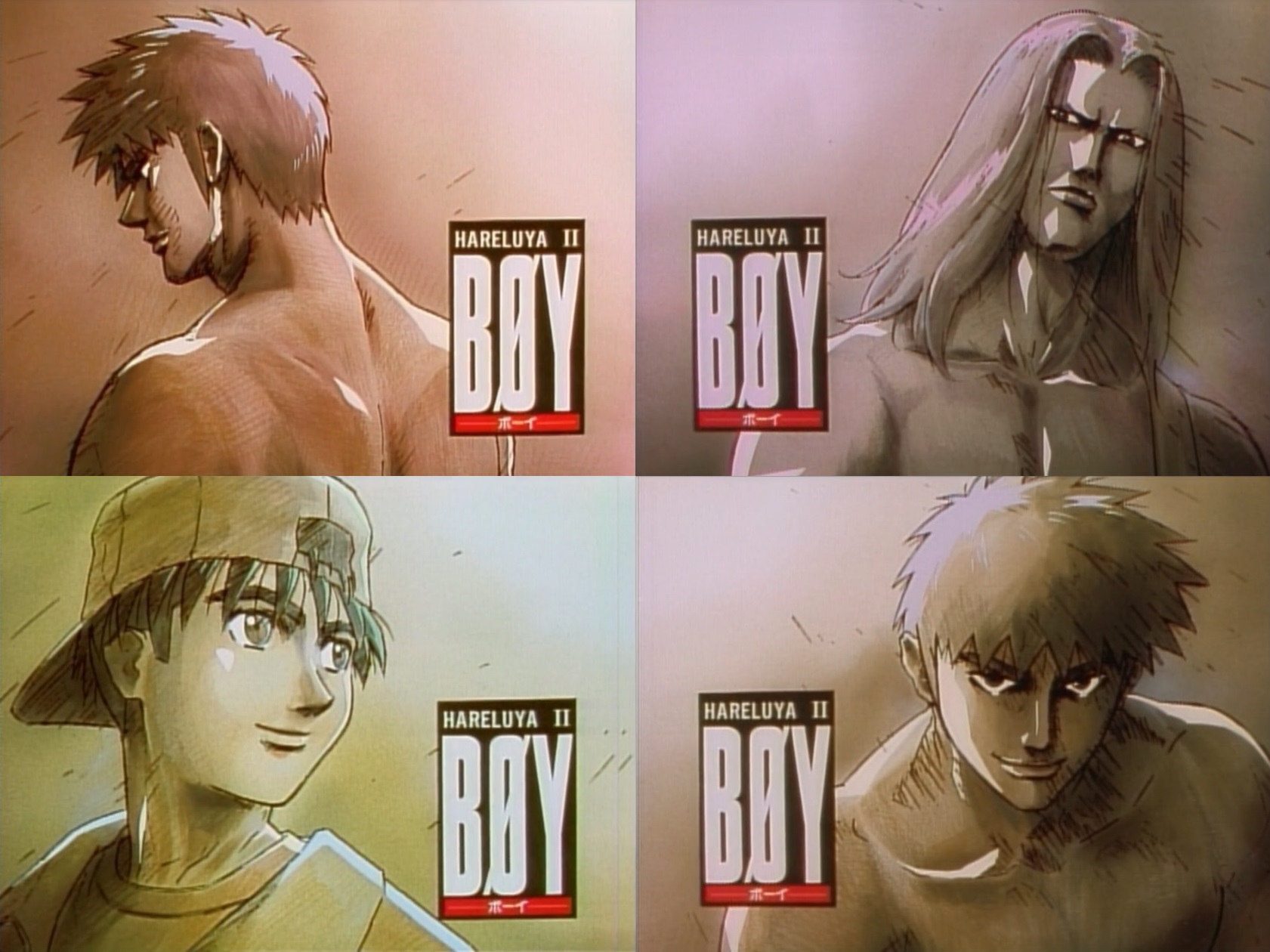
Multiple eyecatches, so you get four of them!
Hallelujah, Hareluya!

In February of 2020, just before the pandemic started, various Japanese digital outlets suddenly started offering the Hareluya II BØY anime, quite literally from out of nowhere. Considering that this was an early example of "modern" late-night anime, & especially the production committee model, I had the feeling that there was something bigger behind this, as there's no way that Shueisha, TV Tokyo, King Records, & Yomiko Advertising (the members of this show's production committee) would just suddenly come back together & make the show available in full digitally in Japan for no real reason; something had to bring this committee back together. My hunch would end up being right, as in November of 2021, Sentai Filmworks announced that it had licensed Hareluya II BØY, & that Hidive would start streaming it later that December with one new episode every week, almost like a "retro simulcast", if you will; seriously, Hidive should have promoted it like that. Now that all 25 episodes are readily & easily available on Hidive, with a complete home video release planned in the future (the first since the VHS & LD release in Japan!), I think it's time to finally re-watch the Hareluya II BØY anime, this time with a full English translation (by "Twin Translators" Alethea & Athena Nibley) that's actually good, & see if there's anything new I can appreciate from this show, now that I can fully understand it from start to finish.

The fact that 2022 is also the 25th Anniversary of the anime, & 30th Anniversary of both the BØY manga & the original Hareluya that came before it, is just fun & cool coincidental timing.

Tuesday, May 10, 2022

Obscusion B-Side: Prowling the Official Atari Jaguar Catalog: 1994 (Part 3)

"When the main competition at the time, the Sega Genesis & Super Nintendo, were offering the likes of The Lion King, Mickey Mania, Pitfall: The Mayan Adventure, & (exclusive to the SNES) a little game called Donkey Kong Country during this very same end-of-year time frame, these new games so far on the Jag just weren't doing it, chief; Doom can only do so much on its own. Can the second half of the Holiday roster pull up the rear?"

It's December of 1994, the end of the Atari Jaguar's first complete calendar year, and things are... mixed, to put it nicely. Out of the 13 games I've covered so far (which averages to just under one new game per month), I'd argue that only four of them are actually must-owns (Tempest 2000, Wolfenstein 3D, Alien vs. Predator, & Doom), while a fifth (Cybermorph) remains the pack-in game, i.e. you're stuck with it; the remaining eight games are either just OK or utterly terrible. Luckily, just in time for the Holiday season, the Jag's got four more games coming out in December, three of which all on the same day as Bubsy in Fractured Furry Tales! So let's finish up 1994 & see how exactly the Jag closed out its first calendar year.

"Prepare to Enter the Combat Zone!"... Awww, here it goes!


Even with a catalog of only 50 officially licensed games released on cartridge, there are some Jag-exclusive games that have come to truly "define" the console, i.e. the ones that are almost instantly brought up right away. So far, we've managed to only cover the ones that are excellent (Tempest 2000 [at the time, at least] & AvP), but now we comes to one of the ones that's used to disparage the console: Kasumi Ninja. Developed by UK-based Hand Made Software, which had previously developed games for the Atari Lynx, this December 9 release (though some places also say December 21) was originally codenamed "Ninja Puncher" & was actually one the very first games announced to be in development for the Jaguar. Not just that, but the game itself was very different from the final product, as while it was always intended to be a 2D fighter using digitized actors, in an attempt to replicate the success of Midway's Mortal Kombat, Hand Made Software originally went with a different visual style than the final product & planned on a roster of 20 playable characters. Atari Corporation, though, meddled a lot during development, resulting in the final product only having eight playable characters, partially due to Atari also forcing the game to be shipped on a cart with less memory than originally planned, likely to keep production costs down. However, the final game was on a 4 MB cart, the largest the Jag offered, so how big was going to be, originally? So... is Kasumi Ninja as bad of a Mortal Kombat wannabe as it's generally deemed to be online?

Monday, April 25, 2022

Twelve Older Anime That Deserve License Rescues XII: Duodenary Decisions Part 2

In an English anime industry that's now only become more & more contracted over time (remember, FUNimation technically dies after this May!), it is something to think back at the 00s bubble days & considering how many "major" names there were, all vying for the biggest slice of the pie, and each of them having at least one or two titles that made them giants for a period of time. Because of that, though, I have been able to continually make license rescue lists like these consistently for 12 years, and as titles go out of print for long enough I could theoretically keep it going until the end of time. Who knows, maybe I can at least stretch this out for another 8 entries & make it to #20!

Speaking of something being made to celebrate a 20th of some sort.... G-Saviour!


On the very first license rescue list back at the start of 2011, I included both G Gundam & Gundam Wing as a double entry, and while both have since happened as part of Right Stuf's working relationship with Sunrise, in retrospect it was a little silly to do that, since Bandai Entertainment was still actually around at the time; that company wouldn't get killed off until 2012, an entire decade ago! Even after Bandai Entertainment got killed off, though, I still pretty much never really considered adding another Gundam production to any of these lists, mainly because I figured that the franchise was too big to never be given another chance. Not like I would have had much time to consider them, anyway, since Right Stuf announced its partnership with Sunrise in 2014, with said partnership still going strong to this day. That said, there really isn't much left in the Gundam vault for Right Stuf to release that hasn't been released before, let alone stuff that actually did see release in English back in the day...

Monday, April 11, 2022

Twelve Older Anime That Deserve License Rescues XII: Duodenary Decisions Part 1

It had to happen at some point, right? Eventually, a "Twelve Anime" list was going to hit twelve iterations, and it only makes perfect sense for it to happen on the 12th year of this blog. So do I have anything special to celebrate the 12th entry in the yearly license rescue list? After all, the number "12" has a lot of importance to it, as it's the smallest abundant number, the largest single-syllable number, is the number that time itself is effectively based around (both in seconds, minutes, hours, & days!), is the number of signs in both the Western & Chinese zodiac, has all varieties of relevance to various religions & mythologies, & is the total number of Earthly Branches. Surely there's some relevance to these twelve entries for this twelfth edition of "Twelve Older Anime That Deserve License Rescues"!!!!!!!!!!!! (That's twelve exclamation points, people)

Not really, but we can at least start things off with the "Most Dangerous" anime of all time.


There was once a time when M.D. Geist, short for "Most Dangerous Soldier Geist", was often cited as one of "The Worst Anime of All Time", though today it's honestly rather silly & even quaint to think of it like that; today, it's a roughly-produced anime take on violent 80s Hollywood action movies, warts & all. Still, there's no doubt that this 1986 OVA created by Koichi Ohata (though due to him only being 24 at the time, Hayato Ikeda was the credited director) & written by Riku Sanjo (who'd later see success with Dragon Quest: The Adventure of Dai & various Heisei Kamen Rider shows) wouldn't have achieved the notoriety it received if it wasn't for a single man: John O'Donnell, the founder of Central Park Media. At some point the boss of CPM found out about this OVA, likely from the legendary 1988 Gaga Communications anime reel (where it was titled "Thunder Warrior"), but O'Donnell seemingly became instantly smitten with M.D. Geist, releasing it on VHS & LD in 1992/1993, where it apparently became one of the earliest anime to ever enter Billboard's Top 10 video charts; CPM even made Geist himself (in full armor) the literal mascot to the U.S. Manga Corps label. With that kind of success, O'Donnell would then work with Ohata directly to create EVEN MORE GEIST, resulting in the 1996 trio of M.D. Geist: Director's Cut (which added in five minutes of new footage & rearranged some things), a comic book adaptation by Tim Eldred, & even an OVA sequel, M.D. Geist II: Death Force.

Friday, April 1, 2022

Obscusion B-Side: Hong Kong '97 vs. Hong Kong 97: The Final Showdown of Ultimate Destiny

The year 2022 will mark the 25th Anniversary of the "Transfer of Sovereignty Over Hong Kong", when the United Kingdom gave control over the island of Hong Kong back to the People's Republic of China, as per the extension agreement made in 1898, when the Qing dynasty was still around; while it's often referred to as "99 years of British rule", the actual full reign was 156 years. If you are hoping for a look into the intricacies of life in Hong Kong during the past quarter century & how China has treated the island & its populace ever since, then I must apologize. Besides, I'm sure there will be people doing just that when the actual anniversary of the transfer comes to pass on July 1. However, this was a very notable moment in world history, so naturally there were a variety of movies, books, & stories that based themselves around this moment, to some extent. Some, like 2014's The Midnight After, looked at things from the perspective of those living in Hong Kong itself, while others, like Rush Hour, Chinese Box, & James Bond novel Zero Minus Ten, make the handover itself a notable part of their plots.

However, two productions (a movie & a video game) made the then-future 1997 transfer of Hong Kong from Britain to China the focus of their actual titles! I mean... how can I NOT pit them against each other?!


Released straight-to-video on November 9, 1994, Hong Kong '97 was a ~91-minute movie directed by Albert Pyun (Captain America ['90], Cyborg), written by Randall Fontana (who'd reunite with Pyun for 2010's Bulletface), & starred Robert Patrick, Ming-Na Wen, Brion James, & Tim Thomerson. It went on to receive a mixed reception & more or less would be forgotten with time after Trimark Pictures (Warlock, Leprechaun) released it on VHS & laserdisc; it's since never seen an official re-release of any sort. The following year then saw something of almost exactly the same name see unofficial release in Japan... barely. Released whenever-the-hell in 1995, Hong Kong 97 (note the lack of an apostrophe, because that is essential in differentiating between the two), or "HONGKONG 1997" on the cover, was produced by Happy Software Ltd., or HappySoft for short. This was a company based out of Shinjuku & run by Yoshihisa "Kowloon" Kurosawa, a notorious Japanese writer who has made a small name for himself in certain circles for traveling to various "underground" regions within Pacific Asia & writing travel journals about all of the seedy, illegal, & just messed up stuff he saw. Kurosawa, however, was also a fan of video games, and would hire people he knew to program satirical & cheap PC games for unofficial release, like a strategy game that parodied Aleph (formerly Aum Shinrikyo). After finding out about various backup devices that can rip video game cartridges to 3.5" floppy disks, Kurosawa decided that he'd give releasing a game for the Super Famicom a try.

So, after hiring a programmer friend who worked at Enix to help him, Hong Kong 97 was completed in just two days, and after hiring someone else to translate the on-screen text (so the player can choose between Japanese, traditional Chinese, & English), he sold the game via mail order for ~$20 (or $37.23, in 2022), allegedly on both floppy disk & cartridge (though no one can confirm the latter)… and Kurosawa wound up selling around 30 copies, before simply forgetting that he ever made it. However, unlike Albert Pyun's movie, Kowloon Kurosawa's game would eventually find itself notoriety online during the 00s, as someone wound up ripping the rom & distributed it online. Then, in 2015, YouTube video pioneer James Rolfe covered Hong Kong 97 as Episode 134 of Angry Video Game Nerd, during which Rolfe also brought up Pyun's movie, due to their nearly-matching titles; Rolfe's video has since been viewed over 9.7 million times. Later, much smaller channel Ultra Healthy Video Game Nerd wound up getting hold of the floppy disk release itself in 2018 & even did an in-person interview with Kurosawa himself in 2020 (following Kurosawa's 2018 interview with the South China Morning Post), and today the full story of Hong Kong 97 is readily available for anyone to find out.

However, one question remains left to be answered:
WHICH HONG KONG (')97 IS BETTER?!?!?!?!?!?!