Monday, August 21, 2023

Obscusion B-Side: Frames, ARKs, Presidents, & HOUNDs: A Look at FromSoftware's Un-Armored Cores

Founded on November 1, 1986 by Naotoshi Zin, Tokyo-based FromSoftware initially made its name as a developer of various business applications for mainframe computers, as well as agricultural applications like managing pig feeding. By the end of the early 90s "FromSoft" decided to transition over to game development, and eventually would "debut" with the release of King's Field for the PS1 on December 16, 1994. After two sequels to King's Field over the next two years (which were the two that saw release outside of Japan, albeit with altered numbering), FromSoftware would debut its fourth video game, Armored Core for the PS1, on July 10, 1997, with a sequel (Project Phantasma) coming out later that December. This would mark the start of FromSoftware's most successful & iconic series for the longest time, so much so that from 1997 to 2006 there was literally at least one Armored Core game released per year, with 2004 even seeing three released! It wouldn't be until Hidetaka Miyazaki truly made his mark with Demon's Souls on PS3 in 2009 that FromSoft had something that would actually surpass Armored Core, resulting in a stretch of time from 2014 to 2022 where the studio would make almost nothing but "Soulsbourne" games, i.e. titles made in the same (or at least very similar) vein as that of Demon's Souls; games of this type not made by FromSoftware are called "Soulslikes". The only exceptions would be a 3DS port of a 2010 Monster Hunter spin-off PSP game in 2015 & a PS VR adventure/horror game in 2018, though Soulsbourne games would still see release those same years.

However, and this is something that has often been lost on people over the past decade, there was so much more to FromSoftware than just Soulsbourne, Armored Core, & even King's Field.
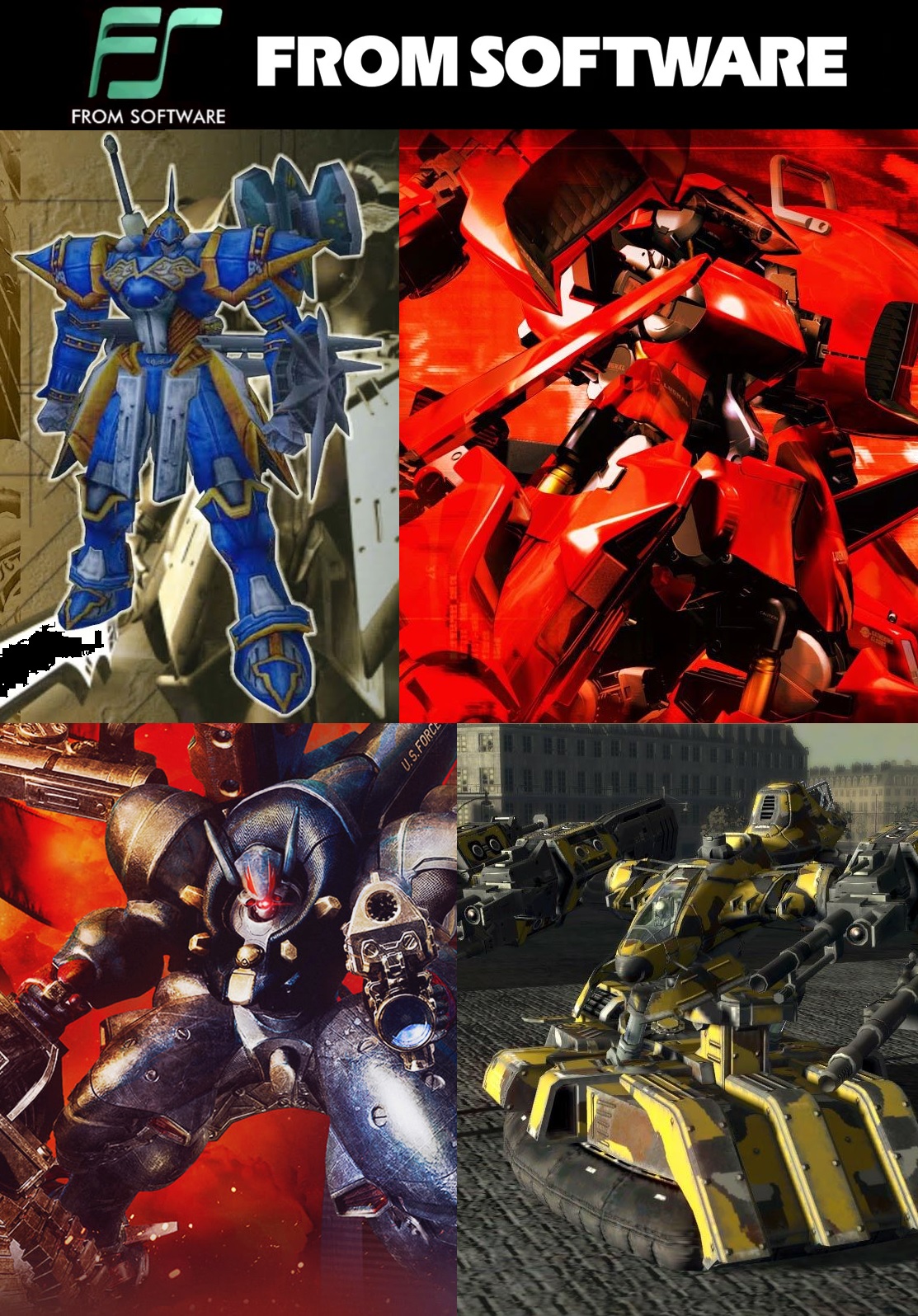
Which one of these got an actual model kit?
Hint: Not the one you're likely thinking of!

Prior to Soulsbourne games making FromSoftware synonymous with dark fantasy (though the studio had always been known for that, since its very first game), the studio was actually more known as a studio that specialized in giant robots. In fact, FromSoft was so synonymous with mecha that it would also be hired to develop games based on other companies' IPs, namely Sunrise's Gundam Unicorn, Capcom's Steel Battalion (though the less said about that Kinect-only game, the better), & most notably Banpresto's crossover series Another Century's Episode/A.C.E. (though the less said about the PS3 game, the better). All that being said, though, it wasn't just Armored Core games & licensed IP titles that FromSoftware developed when it came to mecha, as there are four standalone games involving giant robots that came out in Japan between mid-1999 & mid-2006, i.e. Demon's Souls was only just barely starting development by the last one. Two of them (later three) would see international release, but most notably all of them came from different staff within FromSoftware, with very little carryover beyond some producers & music/sound staff member Kota Hoshino (who's still with FromSoft to this very day, but hasn't composed music for games since 2013), showing a remarkable amount of variety in style, tone, & execution within a shared overall concept of "giant robots". So, to mark FromSoftware's return to mecha with the release of Armored Core VI: Fires of Rubicon, let's take a look at what can be best described as the studio's "Un-Armored Cores".

Monday, August 14, 2023

Television Spectaculars Across the Grand Line! A Look at the Original Four One Piece TV Specials

While they're still done on rare occasion to this day, the concept of the "TV special" has certainly lost the luster it once had. In an age where streaming is king & traditional TV slowly loses more & more relevance with time, the traditional TV special has more or less been replaced by what's now called "event television", which prioritizes being aired live so as to more entice people to tune in, whereas the normal TV special was, more often than not, pre-recorded. Now while "event television" can't really be possible for anime by its very nature, the idea of producing anime TV specials has also become less & less prevalent with time. For example, the Lupin the 3rd franchise was, for the longest time, known primarily for its yearly anime TV specials, as from 1989 to 2013 there was one every single year, but in the decade since 2013 there have only been three, due to TMS deciding to instead return to producing new Lupin TV series "Parts", which works much better with today's focus on weekly simulcasting.


One series that has an interesting history with TV specials, though, would most certainly be the juggernaut known as One Piece, based on the Shonen Jump manga by Eiichiro Oda. What most people might know of is the time from 2012 to 2018, as Toei produced nine One Piece TV specials during that time for Fuji TV's Premium Saturday time slot (literally one or two per year), either acting as recaps of iconic story arcs with brand new animation (Episode of East Blue, Episode of Nami, Episode of Skypeia, etc.), original stories meant to fill in gaps that the manga never covered (3D2Y, Adventure of Nebulandia, Episode of Luffy), or to simply promote an upcoming movie (Heart of Gold). However, these TV specials were actually the second batch for the series after a seven-year hiatus, because from 2000 to 2005 Toei had produced four other One Piece TV specials, and while those later ones from the 2010s mostly got licensed by FUNimation & officially released in English, that original TV special tetralogy has remained exclusive to Japan to this very day, though they were all fansubbed at the time; SP5 to 7 were also never licensed, admittedly. In comparison, even the older One Piece movies that never saw release in North America (i.e. Movies 1-7 & 9) at least eventually saw sub-only DVD releases in the UK in 2014! However, despite never being licensed, these TV specials do have official English titles either via data books released by Viz or simply via Toei Animation itself, and I'll be using those for this overview. The last time I actually covered One Piece here was way back in 2012, when I reviewed the 1998 anime pilot produced by Production I.G., but it can be argued that these first four TV specials are even more obscure & forgotten today than Defeat the Pirate Ganzack! is, especially since that pilot was acknowledged in Japan while promoting 2022's One Piece Film: Red, as both were directed by Goro Taniguchi. Are these old TV specials lost treasures worthy of the future Pirate King, or have they become the One Piece anime's own meta equivalent of the Blank Century for good reason?

Monday, August 7, 2023

Obscusion B-List: 4:3-Only Wii Games That Resisted Widescreen

When it comes to imagery, one of the most important things to consider, from a compositional perspective, is aspect ratio. This determines the height & width of an image & makes all the difference in how something is framed within said image. When it comes to moving pictures, whether that be film, television, or gaming, aspect ratio has played a major role in helping define them. For example, up until 1953 theatrical film used a slightly rectangular 1.375:1 aspect ratio, but once television (& it's ~1.333 aspect ratio, a.k.a. "4:3") started becoming more prominent & popular Hollywood studios decided to start filming in wider aspect ratios, eventually finding 1.85:1 (a "widescreen" aspect ratio) to be the most common standard. This was mainly because it offered an experience that 4:3 TVs couldn't properly replicate without either utilizing letterboxing (so as to offer the full image, though now smaller) or "pan & scan" (which artificially added camera "movement", so as to maintain proper attention). Though first sold as early as 1993, widescreen TVs wouldn't really become more widely available until the mid-to-late 00s, & today the idea of "aspect ratio" is mostly moot, as the standard 16:9 or 16:10 ratios that TVs & monitors come in now are compatible with most widescreen presentations (though there will be some letterboxing for the wilder ratios, like CinemaScope). In fact, watching anything 4:3 on modern screens requires pillarboxing to accommodate things, to some people's dismay (but, please, don't ever stretch the image!).

But how did all of this affect gaming?


While there was the rare game now & then that offered a widescreen option, usually by way of either letterboxing (though some faked this by just cropping the image) or anamorphic widescreen, 4:3 "standard definition" (or 3:4, for "tate mode" games, like many shooters) was the domain of video gaming until the launch of the Xbox 360 in 2005, followed by the launch of the PlayStation 3 in 2006. Both of these consoles were designed to be played in "high definition" (i.e. 720p, 1080i, & 1080p), which by their nature were (generally) 16:9 widescreen resolutions, and while there were some games released on those consoles that offered 4:3 display options (most notably the Halo & Gears of War games, even all the way into 2013!), every single game released on these consoles were developed with 16:9 (or, at least, widescreen) in mind. However, also released in late 2006 was Nintendo's then newest console, the Wii, a console that didn't support HD at all & only topped out at 480p resolution, i.e. 4:3. Despite this, most games released on Wii (&, to no surprise, the Wii itself) did offer anamorphic widescreen support, and there are even some Wii games that are actually widescreen-only & will force letterboxing on a 4:3 display. However, there are also Wii games that, shockingly enough, were designed to only ever display in 4:3, and this was something that most people didn't even realize was a thing until the console's successor, the Wii U. At first the Wii U would simply display all Wii games in widescreen, but an early update regarding "Wii Mode" actually made the console force pillarboxing for 4:3-only games. To be fair, there were some reports about 4:3-only games as early as the Wii's launch in 2006, but the Wii itself actually didn't force pillarboxing (to my knowledge, at least), so most people wound up unknowingly stretching the image if they were using widescreen TVs & didn't adjust the screen manually.

Eventually, a Github user named Gingerbeardman created a complete database of every single Wii game (both physical & digital) that only displayed in 4:3 using the Dolphin emulator & vWii, and after removing things like duplicate listings, Virtual Console, & auto-generated INI files, I collected the list into an easier to read Excel format for myself. In the end, the Wii wound up with a total of around 513 games that are 4:3-only (or ~31.28% of the entire catalog), 399 released physically & 114 released digitally via WiiWare. To be fair, I don't think the list is 100% accurate, as there are a handful of games I know aren't 4:3-only but are on this list, but I think that's within the margin of error, considering where the info was sourced from. What's most surprising, though, is that games of this ilk continued to be made all the way until the Wii U's launch in 2012, a good number of years after widescreen TVs had become standardized & 4:3 was already a bygone relic. So let's take a look at what I feel are the most notable, interesting, or simply weird instances of Wii games that are 4:3-only and see how Nintendo's surprisingly mainstream success of a console was also the last holdout for standard definition gaming.

Monday, July 31, 2023

The Ages of Jump Encore Part 2: Going Out Fighting, Allegro con Fuoco

55 years ago, Shueisha launched Shonen Jump, a biweekly magazine meant to act as a sister publication to Shonen Book, a monthly magazine launched 11 years prior that itself would eventually transmogrify into Bessatsu Shonen Jump, then Monthly Shonen Jump, & finally into the Jump Square that currently exists. In those 5.5 decades of life, Shonen Jump rose from a mere competitor to the likes of Shonen Sunday & Shonen Magazine to the industry-defining standard bearer that, to many, it still is to this day, and the name of "Jump" itself is known the world over. Over the course of over half a century, just shy of 750 different serialized manga have appeared in its pages, but only so many of them would actually achieve something even remotely close to a "legacy" or, at the very least, "recognition", whether that's via renown, notoriety, or simply cult fandom. Over the course of what will now be an 11-part series, The Ages of Jump will have covered only 178 of those manga, or roughly just 24% of Jump's entire catalog; yeah, not even a full quarter of it.

But, really, when all is said & done, one question will remain: "Why go through all of this, and why come back to it twice?"


Because I have always felt that history matters just as much when it comes to entertainment as it does to real life events... and not enough of it is easily available in English when it comes to a subject like manga, even for a topic as popular as Shonen Jump. Over in Japan you can find both manga & even written memoirs from the people who lived through it all, whether it was Shinji Hiramatsu going from assistant to his serialized debut in the 70s, Koji Maki having to deal with cancellation in the 80s, 3rd Editor-in-Chief Shigeo Nishimura recalling his time with Jump from his perspective, or 4th EiC Hiroki Goto looking back on some of the Golden Age's most iconic works. Some of these were even published by Shueisha, but you know Viz more than likely wouldn't be interested in any of this stuff, simply because, for most manga fans, it's history & that isn't what they're interesting in reading about; that's not a slight towards most manga readers or Viz, by the way, but it is a simple fact. I did the original Ages of Jump in 2016 simply because I wanted to (even if only for my own curiosity), I did the Ages of Jump Redux in 2018 because I wanted to do it again for Jump's 50th Anniversary, and the same is true of the Ages of Jump Encore in 2023 for Jump's 55th. If others out there found something cool to learn from all of this, then I am sincerely grateful for that, because it does give the feeling, even if only fleeting, that it did matter. Thank you to anyone who came across this series, & thank you to everyone who felt that it was worth sharing, even if most of it does come off as rather "Wall of Text"-like; that's just how it came out in 2016, & I'm trying to keep consistency across this entire series.

And with that out of the way, let's bring it all to an end with a coda as we re-enter the Golden Age's second half.

Monday, July 17, 2023

The Ages of Jump Encore Part 1: "Play 'Freebird'!"

Close to eight years ago, a.k.a. sometime in late 2015, I came up with the "brilliant" idea of using Wikipedia's list of every single manga that had run in Weekly Shonen Jump up to that point, making note of as many notable titles as I could from that list (either because of length, notoriety, infamy, or simply getting an anime adaptation), and giving a basic & general overview of every single one that I made note of, all in an attempt at maybe providing some context to the evolution of what is, to many, the most iconic & famous manga magazine of all time. To help organize things I relied on the concept of Hesiod's Five Ages of Man (ignoring the idea that each successive age is mostly a worse one than the last), mainly because Jump already had an officially recognized "Golden Age", so I thought it'd be neat to define what came before that point as a "Bronze Age" (Get it? Because it's essentially "third place", in overall importance? Ha ha...) & what came a little bit after as a "Silver Age", while the short period between the Golden & Silver Ages would be a "Dark Age", though later I'd retcon it as also worthy of being called a "Heroic Age", if only to maintain the Hesiod terminology. The end result of that was The Ages of Jump, a seven-part series that took up all of January & February of 2016 (because I was still mad enough to do that much writing & research in that short a period of time, & I've since aged enough to know better) in which I went over 123 different Jump manga, covering from 1968's Chichi no Tamashii to 2014's My Hero Academia. In the end, the series actually did much better than I ever expected, so much so that if you search "Ages of Jump" on Google, the top result is literally a featured snippet listing the four ages that I covered; that makes them all but official, essentially!


With a very positive overall reception, I decided to revisit this concept two years later in August of 2018, to celebrate Jump's 50th Anniversary, as well as fill in some notable gaps that the original series had not covered, but I felt really should have. The end result of that was The Ages of Jump Redux, a two-part series that covered an additional 25 different Jump manga, which also included six series that had debuted after My Hero Academia, starting with Black Clover, and since there was one more Age of Man left from Hesiod that I hadn't used I decided to call this current era of Jump that those six manga came from the "Iron Age". While I don't think The Ages of Jump Redux received anywhere near the same reception that the original Ages did, I was pretty pleased with the end result, which now totaled 148 different Jump manga that debuted between 1968 & 2017; for proper context, though, that's just 19.89% of all Jump manga that have existed, as of mid-2023. Since then, a new resource has come about for looking through Jump's entire history, & that is Jajanken: Weekly Shonen Jump Lab, a literal comprehensive database of every single regular issue of Jump that's ever been made, complete with every single serialized manga that's ever appeared in the magazine's history. Then there's also Weekly Shonen Jump Exhibition Volumes 1-3, a trio of large books that were part art book, part mangaka interviews made for Jump's 50th Anniversary in 2018 that go over a great deal of series that Shueisha itself felt were important to the history of the magazine.

Having gone through the trouble of looking over all 744+ series that have been serialized in Jump (so far) for the sake of figuring out the magazine's history of early cancellations, I came across some last little stragglers that I missed out on over the past nine parts of The Ages of Jump. Some were 100+-chapter series that I really should have included, if only because I feel every series that hit triple digits, in general, should be acknowledged & celebrated, while others were certainly shorter but still had something important worth making note of, especially in light of other pieces I've written (or even made a video of) since doing the Redux. However, I only focused on the original four ages this time around, as while it was fun to take a short peek into the Iron Age in 2018, it's still nowhere near close to ending & should be given time to fully define itself.

So, to celebrate Jump's 55th Anniversary, here's the first of two final (for real, this time!) parts of The Ages of Jump, totaling 30 more Jump manga, with this being the first 15. The concert is over but there's always time for an "Encore", so let's look back at Jump's history once again & (for the last time) see "How Far We've Come".