
Before all of that, though, Satoshi Shiki first truly made his name with a manga that has a little bit of an interesting publication history to it, (originally) simply titled Riot.

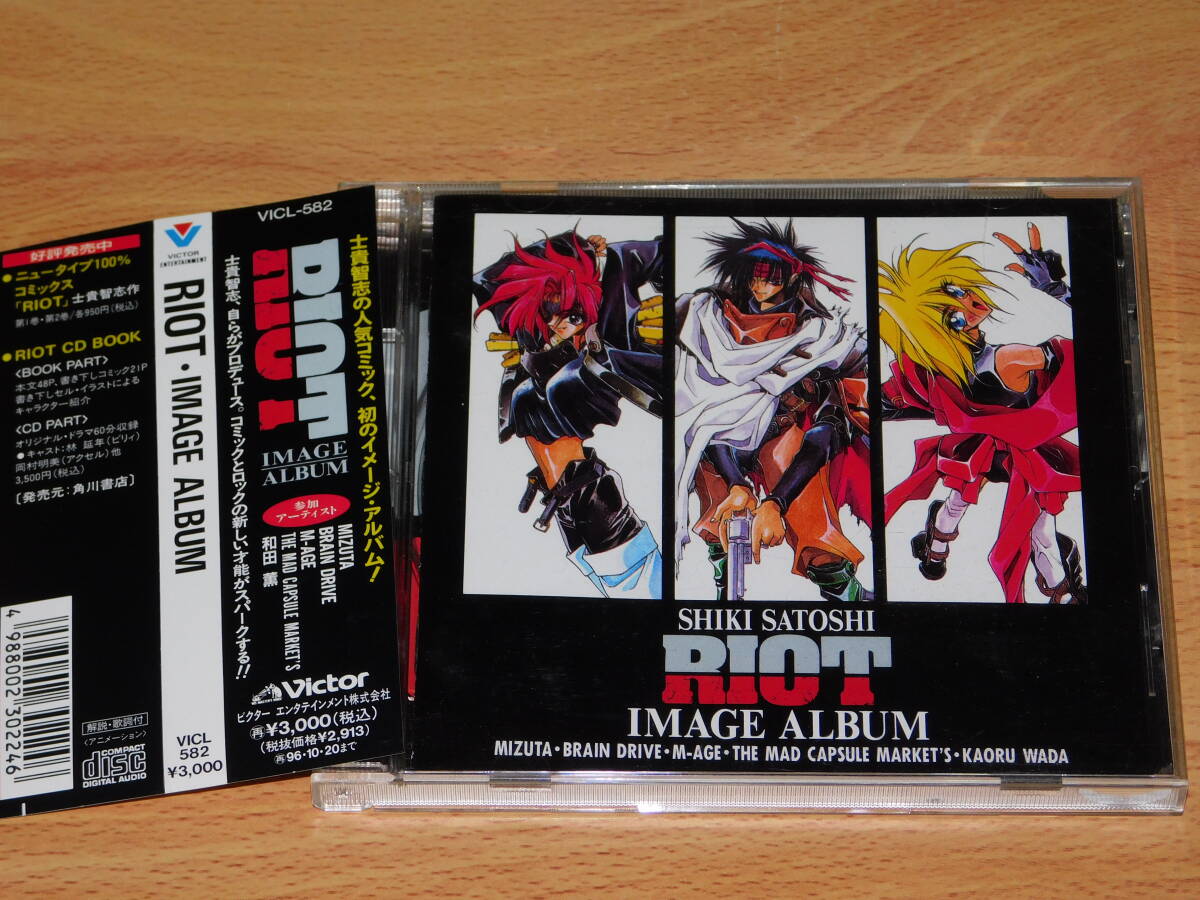
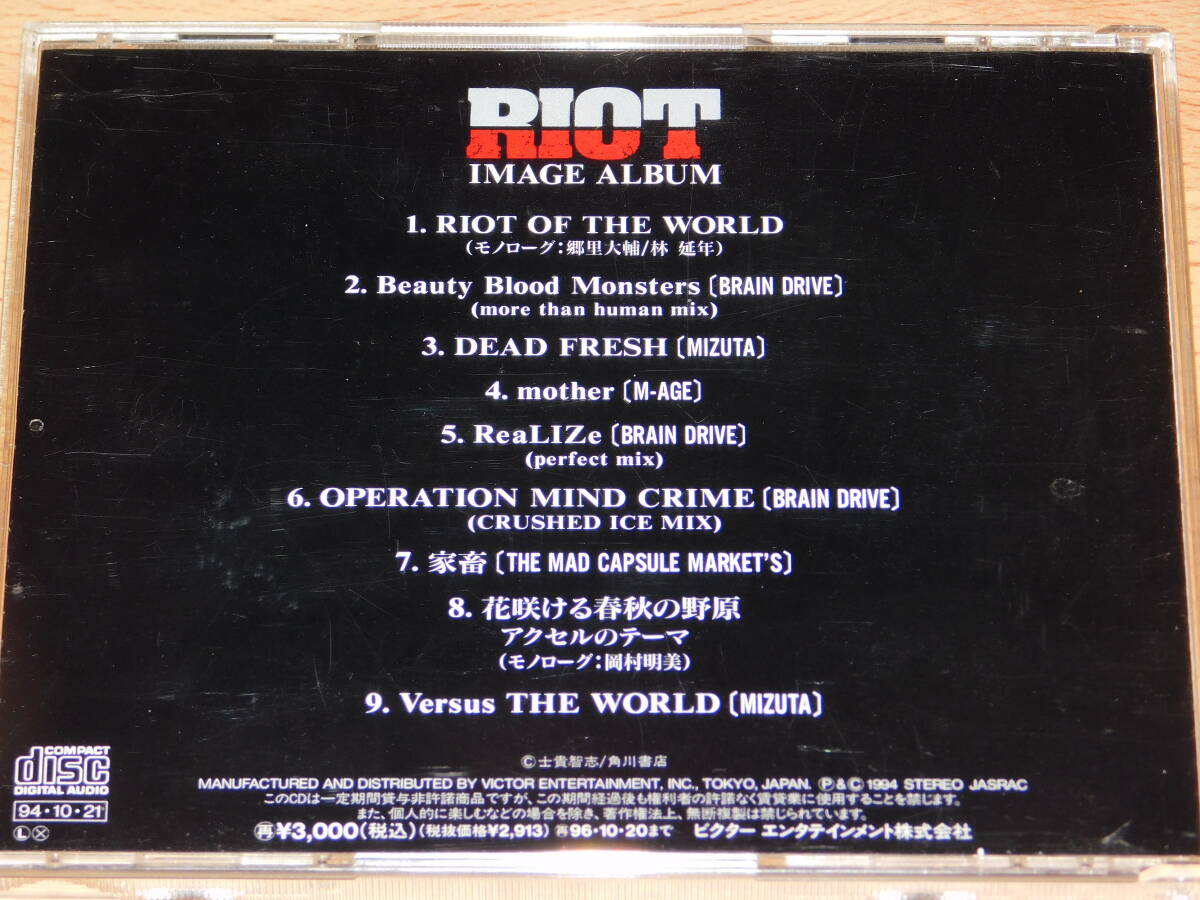
Debuting in the supplemental issue of Comic GENKi that came with the November 1992 issue of Newtype, Riot would be serialized in both Comic GENKi & Newtype (mostly the former, but one or two chapters in the latter) before coming to an end in the May 1994 issue of Comic GENKi, five months before the magazine itself would end & be replaced with Comic Newtype in 1995, totaling two volumes. Despite the short length it still received some promotion & notoriety, most notably a "Kadokawa CD & Book" titled Riot: Yuuhi ni Ochiruboshi/The Star That Fell Into the Sunset that came out in October of 1994, around the same time Volume 2 saw release, & from what I can tell was an original story that could be experienced either via reading the included book or by listening to the included drama CD; Nobutoshi Canna (then Hayashi) & Akemi Okamura voiced the two main characters in it. There was also a Riot Image Album around the same time, which was really more of a collection of pre-existing songs by J-Rock band Brain Drive (plus one song each from M-Age & The Mad Capsule Markets), though Kaoru Wada (InuYasha, Ninja Scroll) was also involved in it, my guess being for the two in-character monologue tracks featuring Canna & Okamura. Someone actually uploaded the album over on NicoNico Douga, minus the monologues, & it's enjoyably 90s electronic rock & (sort of) industrial metal. However, Riot itself was never properly finished, instead merely stopping during a lull in the story. It looks to be that Shiki simply became preoccupied with other work during Riot's serialization, namely his stuff with Shadowrun & also doing work for Metal Hazard Mugen (a planned anime that wound up never making it past pre-production), & his next manga serialization wouldn't be until 1997 with Kami-Kaze for Kodansha's Monthly Afternoon magazine, which would run until 2003. While making Kami-Kaze, though, Shiki would decide to return to Riot in 1998, this time working with Shueisha to not only re-release the initial two volumes, now under the title Riot of the World, but also serialize new chapters that appeared in Ultra Jump magazine.
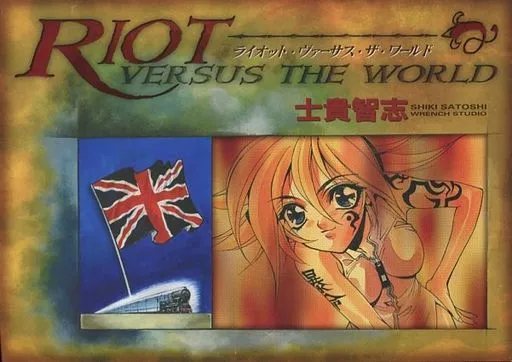
However, this revival was rather short lived, running between Issue #23 of 1998 & Issue #29 of 1999, with only one more volume of content getting made before the manga would go on hiatus for a second time, once again leaving the series unfinished to this very day. However, Satoshi Shiki actually did say in a random response to a quote tweet I made when he shared old artwork of it in 2018 that he would love to return to Riot of the World again one day. I should also note that there is a book out there titled Riot Versus the World that looks to have come out in mid-2001, after Volume 3 of Riot of the World's January 2000 release, but from what I can tell it was a self-published doujin by Shiki & his staff at Wrench Studio, so I have no idea what's actually in the book or if it's even a continuation of the story in any way; it could very be like Bastard!!: Unused・Revised Edition & contain exclusive bits of plot, for all I know. It is worth noting, though, that both the "Riot of the World" & "Versus the World" nomenclature first appeared in that 1994 Riot Image Album I mentioned as song titles, specifically the first monologue & last song; I just think that's neat. Anyway, prior to the manga's return as Riot of the World in 1998 Shiki's original two volumes of Riot saw release internationally, which included an English release by Viz, first via 13 "floppies" (traditional comic issue style, which was still considered the standard at the time) & then later re-released as two proper volumes. From what I can tell this was one of the last manga that had the late James D. Hudnall work on it from a translation adaptation perspective, which is notable as Hudnall was the man Viz had hired to adapt two of its very first releases back in 1987, Area 88 & Mai the Psychic Girl; Hudnall would later also do some lettering work for Viz, but adaptation work seemed to stop after the late 90s. Unfortunately, by the time that third volume of Riot of the World came out in Japan in early 2000 Viz was seemingly no longer interested in putting out more Riot in English, as they had "fully" released all of it by mid-1997. A similar thing would later happen with Beet the Vandel Buster, i.e. more came out long after Viz had "finished" it, so Riot's at least in good company.
When I was first really getting into manga in the mid-00s, after having become an anime fan, I was lucky that some of these flipped trade paperbacks of the 90s were still relatively cheap (they've now generally become more valued with time), so Riot was one of those manga that I read early on in my time as a manga reader & I remember really enjoying it, despite its unfinished nature. Does that remain true for me 20 or so years later? Was that third volume really worth the wait? Is there any reason to go back to Riot & hope that Satoshi Shiki might one day bring it back again? Only one way to find out!

Billy the Kid is a notorious thief who's made his way to a chapel to steal Riot, a grimoire that allegedly holds within its pages the secret of the ancient Western Kingdom's treasure. Upon finding Riot, though, Billy is caught by a young girl named Christopher W. Axel Rose, a descendant of the Western Church who has promised to protect Riot from getting into anyone's hands for the past 13 years (pretty much since she was a small child). Billy manages to escape, resulting in a chase that ends with Axel (accidentally) fatally shooting Billy in the chest. However, Billy's blood lands on Riot, which activates the sentient book & gives Billy an offer: Riot will keep Billy alive, effectively making him immortal, as long as he swears to protect Axel from here on out. With no other option besides death Billy accepts the offer, despite Axel not agreeing with it at first, due to the promise she made to her older brother, Abel. The activation of this magic deal results in a massive light that's noticed by Cain, an old friend of Abel's who's the new High Priest of the Eastern Church that protects the grimoire Phantom, Riot's Eastern Kingdom counterpart. Cain sends assassins out to kill Billy & retrieve both Riot & Axel, as Cain wishes to have both grimoires for his own personal goal of reawakening Abel, who's been stuck in a body much like Axel's for the past 13 years, as well as wanting to crush the Western capital with the Moon, in retaliation for the circumstances that eventually led to Abel's current condition. Not just that, but Billy is also being hunted after by Ritchie Edward, an old ally of Billy's who was thought to be long dead (by Billy's own hand) but is now hunting after him in revenge, alongside Ziggy Rocket Queen, an Eastern Church assassin who failed in her own attempt at killing Billy & wishes to not return to Cain empty handed.
Considering its short length Riot throws a lot at the reader in just the first volume, so let's go over things in categories. For our cast we naturally have our lead, Billy the Kid, who by most indications is a knave through & through. He's foul mouthed (him calling Ziggy a "Bitch!" is done in full English in the original Japanese, as well as a few "Bastards!" thrown out), uncouth, ready & willing to shoot to kill whenever needed, and in many ways is a straight-up jerk. However, even in just Volume 1 you see Billy's softer side, especially in regards to his past, and it's what helps endear him to not just the readers but also Axel. Simply put, Billy has regrets about his past, mainly when it comes to what happened with Ritchie & a woman named Carol (later revealed to be Billy's sister), which resulted in Billy feeling like he had broken a promise, so when left no other choice but to make the deal with Riot in order to keep him alive he decides that he will not make the same mistake as before & will do whatever he can to protect Axel. In turn, Christopher W. Axel Rose (or simply "C.W. Axel Rose" in Viz's translation, as I guess they didn't want to include Axel's masculine first name) can be a bit of an easily swayed young girl, going from hating Billy to being all for staying with him over the course of just Volume 1, & even a little at the start of Volume 2, but that can also be explained a bit by her past. More or less, Axel has no experience of the world outside of the Eastern/Western Church schism, she's literally seen coming out of what looks to be a stasis pod only 13 pages into the manga, so despite not initially liking the deal that Riot (the book she promised her brother she'd protect with her life) made with Billy... he's pretty much the closest thing to a non-familial "friend" she's ever had. Therefore, she still feels for Billy when he's in trouble, she gets jealous when she initially sees women be all familiar with Billy, and when he tells her that he'll keep his promise to Riot & protect her she trusts him; without him she'd be all alone again, like she had been for the past 13 years. Luckily for her, Billy is indeed trustworthy, despite still being a jerk to her at points due to his own emotional baggage.

Then we have the villains, starting with Cain... who, quite frankly, is just outright insane & more than a bit messed up. His literal introduction is him staging a coup against the High Priest of the Eastern Church, his own stepfather who brought him into the Church with Abel 13 years prior, so that Cain can become the new High Priest. He then summarily decapitates his stepfather and, while crying over what he's done... "fuses" with his stepfather's head via the power of Phantom. In fact, by the end of Volume 1 Cain has "eaten" just about everyone else in the Eastern Church, including the doctor & even one of his own subordinates (Shishioh, translated literally by Viz as "Lion King"), leaving only Ciphone Campbell (a descendant of Phantom's guardians, similar to Axel for Riot) due to her own magical powers being of potential use to him. Yeah, Cain has definitely gone cuckoo for Coco Puffs, and it's all because he had harbored hatred towards what had happened to Abel shortly after the two arrived in the Eastern Church, not to mention the sheer power of Phantom obviously driving his mind to the brink. Cain's major event with Abel isn't seen until the Riot of the World revival, & even then it's not fully explained, but it left Abel in a body that looks remarkably like his sister's & resulted in Cain harboring such malice towards not just his own stepfather but over the Western capital itself, so much so that his goal is to use the combined power of Riot & Phantom to drop the Moon onto the Western capital(!). Needless to say, Satoshi Shiki picking the song "Kachiku" by The Mad Capsule Markets, which literally has its final minute featuring the sound of a man screaming his head off as though he was being tortured to death (all while an organ can be heard playing in the background), winds up making perfect sense as a song that best represents Cain's descent into, what's effectively, sheer insanity.
In comparison, characters like Ziggy Rocket Queen (amazing name, by the way) & "Speed King" Ritchie Edward are much more straightforward &, for lack of a better term, well adjusted. While Ziggy is initially introduced as a complete stranger to Billy, Volume 2 actually begins with a flashback side story that explains that she had actually met Billy five years prior, as he had helped her out of a pinch back in the day, though the two never shared their names with each other. Regardless, Ziggy's a memorable rival character in her own right, with a neat mechanical eye that can shoot laser beams & an easily agitated emotional state that can turn her from ready to kill to whining like a baby on a dime when things don't go how she planned. As for Ritchie, the most we do get explained about him & Billy is that a situation involving Carol resulted in the two hating each other, cue Billy's (attempted) killing of Ritchie, but he has a neat design to him with two permanently damaged eye sockets (which are usually bandaged up) but also a third eye on his forehead, though whether or not that's a literal third eye is never really established. Finally, for the supporting cast we have Kyrie Cherry Bomb (which Viz tried stating as "Kyrie the Cherry Bomb", but the drama CD cast lists "Cherrybomb" as her last name) & Grey, who honestly don't contribute too much in terms of the plot but do kind of help humanize Billy a bit, though that's more Kyrie than Grey. Hell, Grey doesn't even appear in Volume 2 until around the last third... and Shiki kind of pokes fun at that by having him be confused by everything that's gone down, since he wasn't around for most of it; I think Shiki just straight up forgot Grey existed until that point. The end of Volume 2 also introduces two more characters, Lucy May & Chilrel, but they appear so late into the original run that only Lucy May has any (minor) importance from a plot perspective; same with Karei, another of Cain's female followers who just appears at the end of Volume 2.

As for the pacing, despite the initial run only being two volumes Shiki actually managed to get a decent amount of story into them, even if the main focus of each volume is more or less one big fight each. Volume 1, after setting up Billy's situation with Riot & Axel, is mostly focused on Ziggy's encounter with the gang at a tavern, followed by Billy & Axel deciding to travel with Kyrie & Grey as they all head towards the Eastern Church & figure out just what the hell is going on & why they want Riot & Axel. Volume 2, in turn, takes place after two months of travel (I would imagine Riot: Yuuhi ni Ochiruboshi takes place during this gap?), with Billy now a wanted man & being hunted after by various bounty hunters, which is seen at the start of the book. However, the main focus is on their encounter with Shishioh (now seemingly turned into a mere servant of Cain's... or is he?) teaming with Kuroyasha & Akahana (named "Yaksha" & "Red Nose" by Viz), two wildly malicious Eastern Church assassins, though Ritchie & Ziggy (who met at the end of Volume 1) join in to help our heroes; it's initially for their own reasons, but by the end of the book Ritchie & Ziggy are on the good side.
Admittedly, while the general plot of Riot is honestly easy to follow there are some sudden character-related beats that, while technically established so as for them to make sense, occur so fast that they feel like they come from out of nowhere. For example, by the end of Volume 2 both Axel & Ziggy admit that they've fallen in love with Billy, and while both of them have logical reasons behind them (I went over why Axel's feelings make sense, while Ziggy's flashback story more or less provides context there) they still both feel rather sudden when they each admit their feelings to Billy. The same is true of Ritchie & Ziggy becoming good guys as the end of Volume 1 very much establishes them as potential foils for Billy & Co. moving forward, but once Kuroyasha & Akahana start their attack the two of them decide to help fight the villains. Then, after the fight, Ziggy outright states that she can't go back to Cain anymore, while circumstances in the last third of Volume 2 essentially force Ritchie to put aside his hatred towards Billy (with some encouragement from Kyrie), at least for the time being. Without a doubt it's easy to see that Riot was Satoshi Shiki's first serialization, and maybe he knew that he was going to put the manga on hiatus (so he rushed some things forward so as to halt on a proper stopping point, rather than end on a major cliffhanger), but I think he actually still managed to showcase his talents as a storyteller well enough with these two volumes, even with some flaws. While Volume 2 was mostly focused on the big fight, Volume 1 would cut between Billy's fight with Ziggy & the stuff Cain was doing at the Eastern Church in ways that made sense & never messed with the pacing whatsoever. For as simple & straightforward a story as Riot is there are a lot of fine details that Shiki managed to fit into only two volumes of content, and they certainly help keep it memorable today.

But everything I just said only goes over what's seen in Riot, & namely the version that Viz released in English, which was based on the original Kadokawa-published "Newtype 100% Comics"-labeled volumes... what about the later Riot of the World? Well, to my own amazement, the first two volumes of Riot of the World aren't simply Shueisha-released reprints of what had been published by Kadokawa a few years prior, but instead there actually is some new content to them! Volume 1 adds in three new pages after the fight with Ziggy showing Axel & Kyrie conversing a little while taking a bath, so it's essentially just for the sake of Shiki drawing two women naked, plus a two-page spread at the very end that simply enforces how Ciphone decides to stick with Cain, despite how insane he's clearly become. There are also two outright redrawn panels from Shiki at the start & end, both of which simply redraw Cain & Billy (respectively) on their own; I guess Shiki just didn't like how those two specific panels looked. As for Volume 2, all that was altered were four individual panels throughout that were redrawn (mainly to redraw Billy & Ziggy in some way, though one of them actually did fix a panel that was originally drawn a little awkwardly), as well as two whole pages of new content... which literally just amount to showing more directly that Billy & Ziggy have sex at the end of Volume 2 (nothing explicit, but still more than originally) & a proper establishment of the big fight that the book ended right at the start of. Finally, the first two chapters of the entire manga got renamed for Riot of the World, with Chapter 2 going from "Call Me Young Gun" to "Bousou Shonen/Reckless Boy", while Chapter 1 is now simply "Riot Act"... after originally being titled "Riot Act Mother Fucker"; hey, even in Japan it was the 90s.
Then there's Riot of the World Volume 3, which collects the year-long stint in Ultra Jump & continues directly off of where Volume 2 ended. The first half focuses, as per tradition, primarily on a big fight that was just started at the very end of the initial serialization, namely Kuroyasha (now transformed into a giant monstrosity by the power of Phantom) taking on Ritchie & Shishioh, with Billy helping out later on. Interspersed throughout this first half are bits with Cain as he reveals to Karei the story of how he & Abel first came across Phantom while growing up in the Eastern Church (now given a proper name, Labella de Chella... hey, that's what the katakana reads), all while Cain slowly loses his mental grip on things. Billy also now sports a new mark on his forehead for a short period, not too unlike the mark Axel has under her left eye, indicating that Billy is now the true guardian of Riot & all of its knowledge... including knowing the real names of both Riot & Phantom; it's that knowledge that makes Cain leave his moon drop plan for the time being.
As for the second half, it's focused mainly on setting up what looks to be the final fight of the entire series, as Cain (complete with a new crew of warriors who debut in this book: wire user J.M., quick cat girl Nejire, & swordsman Zakuro) boards a flying ship called the Armadraba (... hey, that's what the katakana reads) & head over to where Billy & Co. currently are. To help Billy & his friends out we also get the appearance of Bud Garrett, a female gunslinger (& sheriff, according to Ziggy) who previously was a part of Billy's crew back in the day, alongside Ritchie, Kyrie, & Grey... and aside from a small unnamed cameo at the end of the flashback side story in Volume 2 (maybe, as the character seen doesn't look exactly like Bud in Volume 3, but that could simply be due to the evolution of Shiki's art style) Bud actually first appeared via Riot: Yuuhi ni Ochiruboshi, so (yeah) that bonus story is very likely to be 100% canon to the overall plot. Shiki also has Grey suddenly reappear (again) in the last third of Volume 3, this time having brought in Bud to help, and I have to imagine that Shiki had Grey's sudden return be a direct reference to how he suddenly reappeared in Volume 2; it'd be funny if that would have been Grey's recurring gag, if more Riot of the World was made. There's also a quick introduction of a third party force, the Karyu Clan, which looks to take advantage of the final battle by seeing which one survives & possibly take them out when weakened; Karei looks to have been a spy for the Karyu Clan (her name & similar forehead mark hint at that), but it's not confirmed here.
Obviously, Riot of the World Volume 3 is 100% essential reading for anyone who's interested in the manga, though it's sadly without any English translation, but it also ends without giving the series anything remotely close to a finish; hell, it even ends on a major (& interesting) cliffhanger this time around! If I had to take a guess, considering the general pace this series tends to have, I would imagine that Shiki would only have around two volumes, maybe three tops, of content remaining to finishing this manga off, honestly.
 |
| I'm relying mostly on scans from Riot of the World, due to it having the highest-quality pages, but here's one from Viz's flipped release. |
As we can see from the overview of the plotting, Riot (of the World) is a rather fast-paced manga, with a lot of stuff happening in each volume & often a number of new characters being introduced, sometimes rather suddenly & without much set up (Zakuro in Volume 3 at least gets kind of an intro, but for someone like J.M. all you get is Ziggy remarking that he should have died a year prior), but I'd argue that the manga manages to rise above those potential hiccups. A large part of that is due to Satoshi Shiki's artwork, which absolutely matches the world of Riot perfectly. While the first volume kind of establishes the world of Riot as more Wild West adjacent (or at least "Weird West") as the manga continues on it establishes more that it's actually a post-apocalyptic world, with desolate ruins of cities destroyed a while back (there's a quick line in Volume 2 about "19 years ago", but I don't know if that's the exact timeframe), seemingly by the combined power of Riot & Phantom being used in the past. Still, it helps give Riot a lot of memorable personality, in & of itself, even in just three volumes, and Shiki gives backgrounds a lot of great detail that helps give the reader an immensely strong sense of where every scene is taking place in. I definitely get a strong Bastard!!-esque vibe when reading Riot, in that regard, and when combined with the strong musical references in numerous character names I can only imagine that Shiki himself was influenced by Kazushi Hagiwara.
And then there are the character designs, which really do showcase why Satoshi Shiki became so quickly relied on for his artwork. While there is the occasional bit where you might confuse one character for another at first, due to some similar facial designs at points, Shiki really does know how to create memorable designs, even from his start as a professional mangaka. Billy the Kid is admittedly a rather simple design, but it's no less effective due to Shiki's detailed style, while someone like Ritchie is instantly memorable due to his third eye & the like. However, I do want to give special attention to Akahana, who aside from his literal red nose (hence the name) has this monstrous & gaping mouth, complete with inhuman teeth, giving him an immediately unforgettable look (even if Akahana tries to hide his mouth behind a shawl, more often than not). Also worthy of specific attention to detail is Cain, who Shiki really enforces the body horror element with as he slowly becomes more & more taken over by Phantom's raw power. While keeping his human form intact he is still able to unleash giant, semi-formed mounds of flesh & whatever else he's fused/eaten into himself to create some truly effective moments, and come Volume 3 Phantom's influence over him becomes so strong that his chest will sometimes form into a giant face, revealing the true presence within Phantom, almost as if it's trying to escape the vessel that is Cain's body.
As for the evolution of Shiki's art between serialized runs it's honestly mostly subtle enough that you likely wouldn't notice them unless you were directly comparing them side-by-side (like I did when going over the differences that Riot of the World Volumes 1 & 2 had over their originals), though his women definitely become more noticeably feminine in some ways, whereas before some of them (namely Ziggy & Kyrie) could sometimes look similar in style to the men. Axel, though, definitely sees the most notable difference in how Shiki draws her, though since she only appears a handful of times in Riot of the World Volume 3 it's really only truly noticeable in Riot of the World Volume 1, specifically when looking at that added scene between Axel & Kyrie; it switches right back to the old art, & you can see the difference in Axel's design strongly. Still, reading Riot (of the World) really does showcase how damn good of an artist Satoshi Shiki is, and why he's become so relied on when it comes to manga adaptations of other's work.

Finally, while Viz's release didn't include it, the original Kadokawa-published Volume 1 of Riot included Tsumi to Batsu, the 1991 one-shot that marked Satoshi Shiki's professional manga debut, so I might as well go over that for this review, as well. As expected, it's not a long story by any means (around 16 pages) & tells a rather straightforward tale about Graham, a young man who lives in a country that's under military rule. While coming home one night he crashes into a woman with a bleeding arm who passes out after their crash, so he takes her home to allow her to recover. When she awakens she tells Graham that she's a part of a recent coup d'état attempt & got shot while on the run, and after a soldier attempts to break into Graham's apartment to capture the woman (& is summarily shot dead by her) he agrees to follow her to the river to escape; while an otherwise normal citizen, Graham is no fan of how the country is being run, either. However, while crossing the river the woman is shot & tells Graham to continue on as she allows herself to get captured so that he can escape, and four years later Graham decides to head back to his old home country in order to exact some "crime & punishment" of his own.
For Satoshi Shiki's first professional work Tsumi to Batsu is a solid enough little one-shot, and while the story itself is pretty simple it's executed well. Shiki's artwork is already seen to be really good here, though his character design work is still early (Graham & the woman he saves honestly have almost identical designs, for the most part), but I can see how getting Tsumi to Batsu published in Comic GENKi eventually led to Kadokawa Shoten deciding to give Shiki the chance to make a serialized manga later on. Honestly, at first I almost thought that this could have been canon to Riot, especially since Graham's "four years later" design is almost a dead ringer for Billy the Kid, right down to the headband, but the flashback side story that starts Volume 2 definitely negates that; I guess Shiki just really like that design & decided to reuse it for Billy. Interestingly enough, the final chapter of Riot Volume 2 would also be titled "Tsumi to Batsu/Crime & Punishment", though Viz would rename it "Intimacies" (Viz would rename all but three chapters in its release, actually), so Shiki must have continued to have a soft spot for his first ever professionally published work; the one-shot & chapter have literally no connection or similarity beyond their titles, though. Still, it would have been nice if Viz included the Tsumi to Batsu one-shot in its collected Volume 1 of Riot, at least as a bonus to entice people to buy it (even if they previously bought the single issues), but I can understand why it wasn't included. I imagine it wouldn't have made sense to include it in a floppy issue, & the trades simply collected what were in those floppies; nothing more, nothing less.
 |
| Huh, that's a lot of covers for a manga made up only two (later three) volumes... |
If I was to explain that Riot was a short-lived & unfinished first serialization for Satoshi Shiki I imagine that it likely wouldn't sound super appealing. Also, there are no doubt flaws within the manga itself from a storytelling perspective, what with its sometimes sudden plot advancement, quick character development, & even action sequences that feature mostly fights that are done rather fast, when all is said & done. However, there's just an inherent moxie to Shiki's first serialized manga that makes it easy to get into & enjoy, with memorable characters & a story that doesn't really want to feature much in the way of fat, all wrapped up in some truly great artwork that shows how talented Satoshi Shiki was from the very start. Without a doubt, though, the ideal form of this manga to read would be Riot of the World, as not only is there an entire third volume of content but also the added bonus of the handful of redrawn panels and some extra pages of content across the first two volumes; sure, said added content doesn't really add anything of note but they certainly don't detract, either. The loss of Tsumi to Batsu does suck, though, so there's still value in at least getting the original Japanese version of Volume 1 of Riot.
However, I highly doubt that Riot of the World will ever licensed for English release, so for the vast majority of those who are curious about this manga then they'll have to rely on Viz's flipped English release of Riot, which obviously has been out of print for nearly 30 years, by this point. And, to be fair, Viz handled the flipping extremely well because while naturally it sometimes results in some altered elements, like Ziggy's eyepatch now being over her left eye instead of her right, anything that featured English text (of which there was a decent amount in the backdrops) was properly redone so that they weren't flipped with the rest of the art, and the sound effects were redrawn into English in a way that even modern day English manga letterers can find inspirational. While some of the manga that was released in English back in the 90s could sometimes feel a little random in why they were picked for release, there are a good number of really damn good titles that came from those bits of seeming randomness, and Riot is definitely one of those good examples.
While he only made appearances in English here & there in the 90s & 00s, Satoshi Shiki has actually maintained a consistent appearance in North America for the past decade due to Kodansha USA publishing Attack on Titan: Before the Fall, followed by Seven Seas publishing The Legend of Dororo & Hyakkimaru, and I'd love to see Shiki continue to see support over here once the latter finishes up in English. While I'd absolutely love to read something like Casshan R I'd also love to see Riot (of the World) be given another shot, even if it may never get finished by Shiki himself.
Manga © Satoshi Shiki


No comments:
Post a Comment