Tuesday, October 10, 2023

Majuu Sensen (OVA): Who Needs "The Father, The Son, & The Holy Spirit" When You've Got "The Bear, The Lion, & The Eagle"?!

Born on June 28, 1948 in Karasuyama, Nasu, Tochigi (now Nasukarasuyama, since merging with Minaminasu in 2005), Kenichi "Ken" Ishikawa would join Dynamic Pro in 1969 after graduating from high school, becoming an assistant to Go Nagai on manga like Harenchi Gakuen & The Abashiri Family, before making his debut as co-creator alongside Nagai with late 1969's Gakuen Bangaichi. Nagai himself has even stated that he never looked at Ishikawa as an "assistant", instead thinking of him as his greatest friend & ally, and that if Ishikawa had managed to join him prior to Harenchi Gakuen's debut (which marked Nagai's "professional" debut) then the two would have likely become like Fujiko Fujio, i.e. two men working under a shared pen name. Ken Ishikawa would then make his solo debut in 1970 with Sore Ike! Combat-tai & over the course of his career would be the creator of numerous manga, with his most notable being Getter Robo, which Go Nagai helped co-create but the manga interpretation (& its numerous sequels) was 100% Ishikawa's vision. Unfortunately, Ken Ishikawa would pass away on November 15, 2006 at the age of 58 due to acute heart failure, collapsing at a dinner banquet he was attending after playing some golf. However, his legacy of wild action, 200% intensity from his characters, & amazing artwork lives on throughout all of anime & manga, most notably in the works of screenwriter Kazuki Nakashima (Gurren Lagann, Kill la Kill, Back Arrow), who proudly calls himself "Ken Ishikawa's #1 Fan".


Since the two were such close friends, it's only natural that Ken Ishikawa had some works that felt inspired, in some way, by the works of Go Nagai, and one example of that looks to be Majuu Sensen/The Demonic Beast Front. Debuting in the pages of Futabasha's Weekly Shonen Action in 1975, Majuu Sensen was a manga that dealt with things like "demons", experimentation in an effort to surpass the limits of humanity by fusing with non-human beings, & the literal apocalypse, making it seem like a direct response to Nagai's iconic Devilman from 1972. Both series even ran for only a single year, though Majuu Sensen was compiled into just four volumes, but in Ishikawa's case that was simply because Weekly Shonen Action itself got cancelled, leaving Majuu Sensen unfinished. Regardless, Majuu Sensen is now considered one of Ishikawa's most iconic works (Type-Moon even full-on used the name for its 2019 TV anime Fate/Grand Order - Absolute Demonic Front: Babylonia), & the design of lead character Shinichi Kuruma has been paid homage to every now & then, most notably in how Ryoma Nagare dresses throughout the OVA series Getter Robo Armageddon in the late 90s; in fact, mangaka Shinichi Kuruma (Majinden/Battle Royal High School) literally names himself after the character! Therefore, it's not surprising that Majuu Sensen would get adapted into anime at some point, in particular twice, one being a direct adaptation of the manga & the other being an alternate universe sequel. Seeing as it's the month of October, let's get a little horror-themed & check out both of these anime adaptations of Majuu Sensen, one of which for the second time.

Naturally, we'll start with the first one, a three-episode OVA (though they were all ~45 minutes long) produced by Animate-Film/MOVIC & J.C. Staff that (interestingly enough) actually came out all at once, first on VHS on October 1, 1990 & then on LD on December 1 later that same year. The OVA was also given a short theatrical run in Theater Ikebukuro from October 13 to 26, 1990, & on February 22, 2002 (that's a lot of 2s) would get re-released on DVD; sadly, though, the OVA has not been re-released since then, & it's not even streaming anywhere in Japan. Nevertheless, let's see how the OVA adaptation of Majuu Sensen holds up over 30 years later & in what ways Ken Ishikawa differed in his take on a "Dynamic Armageddon" from Go Nagai's Devilman.

Monday, September 25, 2023

Obscusion B-Side: The IF Neverland Reportage: Prelude to a New War

Previously on The IF Neverland Reportage:
"Without a doubt, the earliest games in the IF Neverland franchise can be evenly split into two halves that alternate with each successive game we've covered. One half is the more experimental games, with mixed results... Still, where Spectral Force 1, 2, & Lovely Wickedness succeeded was in defining a fantasy world filled with unique & varied characters, all vying for control over one primary continent... but what happens AFTER one side claims victory?"


While Idea Factory started off with a small variety of different IPs, it quickly became obvious that the games taking place in the fantasy world of Neverland were the ones that seemingly got the most attention, even if a mixed critical reception tended to accompany them (or perhaps it was even due to that). This was seen most in the year 1999, which saw IF release six games (a number that wouldn't be topped until 2004, with the introduction of the IFMate brand), all of which were for the PlayStation but only one of which (Oasis Road) had nothing to do with Neverland. Last time we only covered the first two IF Neverland games released in 1999, and this time around we'll be mostly focused on the remainder of that year, as well as the pair of titles released in 2000, one of which brings an end to not just IF Neverland's time on the PS1, but also Idea Factory's time with the console as a whole.

As for the lore of IF Neverland, Idea Factory find themselves in an interesting place, as Spectral Force: Lovely Wickedness brought an end to the Great Neverland War, the major conflict that all of the IF Neverland games up to this point had some relation to, whether it was letting players experience the war themselves or showing the adventures some of the war's players had in the years before it broke out. Where, then, would Idea Factory go from there on out? Well, eventually, they would start to show what was happening in the Main Neverland Continent in the aftermath of the war, one that would act as a prelude to a second continental war, but first we have a couple of retreads to go over...

Monday, September 11, 2023

Obscusion B-Side: Prowling the Official Atari Jaguar Catalog: 1995 (Part 3)

"With the Jag now having actual major competition on the North America market in the form of the Sega Saturn, even with the console experiencing its own rough (& unintended) start, Atari needs more games like this bunch if it wants any chance at being able to stand next to Sega & Sony (as well as Nintendo, though its next console it still a year away) as a legitimate competitor, even if only to a limited extent."

It's July of 1995, and the North American video game market is in a bit of flux. While the Sega Genesis & Super Nintendo are still strong sellers, with the SNES on the verge of finally surpassing the Genesis in yearly sales come the Holiday season (for a multitude of reasons), Sega of America's early launch of the 32-bit Saturn (a decision forced by Sega of Japan, though it was due to SoA's own financial mistakes costing the entire company dearly) hasn't really managed to make much of any impact because of a slow & staggered roll-out nationwide, alongside a slow trickle of new releases due to the surprise launch screwing over SoA's development & publishing partners' initial plans; meanwhile, the Sony PlayStation is still set for a September launch. This gives the Atari Jaguar a little bit of a theoretical opportunity, but in the two months following our last title covered (Super Burnout) there will only be five games released for the Jag. For comparison, even the 3DO saw nine games during that same time period, nearly twice as many, and that console wasn't doing too much better by mid-1995. Still, the prior five games covered last time were all good games, with some even being great games, so let's see if the Jag can continue that momentum right up until the launch of the PlayStation.


Something that the Jaguar has had a bit of a dearth of are puzzle games, with launch title Evolution: Dino Dudes (a.k.a. The Humans) being the sole example of the genre on the console up to this point, and even then that was more of a puzzle-platformer. In terms of "pure" puzzle games there would only be two released on the Jag, with the first one being FlipOut!, released on July 7, just two days after Super Burnout; it'd also receive an MS-DOS port in 1996, but only in Europe. One of the very first games ever developed by Gorilla Systems, a studio that would be known mainly for developing licensed IP titles (Barbie, Disney, etc.) & porting games to other hardware, FlipOut! is a tile-matching puzzle game that actually saw video game journalist Michael Price from Electronic Gaming Monthly work as a tester on the game, playing prototype builds & giving feedback & suggestions that he felt would help improve the game, which he'd later admit was developed on a low budget. Interestingly enough, Atari didn't actually publicly reveal FlipOut! until E3, just two months prior to release, so one has to wonder if the game was simply developed in secret until it was ready... or if Atari Coporation simply decided to toss it out ASAP just so there'd be two new games for the Jag in July, as the next game wouldn't come out until August. Guess there's only one way to find out...

Monday, September 4, 2023

Obscusion B-Side: It's All About the Ataris, Baby... The Companies, Not the Punk Rock Band

There are only so many words in any language, so it's only natural that people only have so many words to name a company that they start up with, & it's not surprising to come across two different companies with effectively the same name from the same industry, so much so that calling them by a shorthand can lead to confusion. When it comes to video games there are plenty of examples of that. For example, we have Access Games (Deadly Premonition) vs. Access Software (Tex Murphy), Sonic Team (Sonic the Hedgehog) vs. Sonic! Software Planning (Shining Force), Climax Entertainment (Runabout) vs. Climax Studios (Rocket Knight [2010]), Gremlin Graphics/Interactive (Top Gear) vs. Gremlin Industries (Head On), MileStone Inc. (Chaos Field) vs. Milestone s.r.l. (MotoGP), Monolith Productions (Middle Earth: Shadow of Mordor/War) vs. Monolith Soft (Xeno Series), & Piranha Bytes (ELEX) vs. Piranha Games (MechWarrior 5), among many others; hell, this can even apply to a single letter, as seen with Q Entertainment (Lumines) vs. Q-Games (PixelJunk Series)!

In other instances, though, two different companies can have the same name because the trademark itself was sold off. For example, T&E Soft changed its name to D Wonderland Inc. in 2002, only to then sell the "T&E Soft" trademark to another company in 2005, which eventually resulted in a completely different studio called T&E Soft that existed between 2008 & 2013, followed by D4 Enterprise acquiring the rights to both the T&E Soft name & all of its games and IP in 2019, all while D Wonderland Inc. (the "original" T&E Soft, now Daikokuya Global Holding Co., Ltd.) continued to operate & is still around to this very day. However, when it comes to the "same name game" in the video game industry, there's only one undisputed king of confusion: Atari.


The Japanese word "当たり/atari" can be translated into many words, but for our context comes from Go, a Chinese board game dating back to at least sometime in the mid 6th century BCE & wouldn't actually be brought over to Japan until sometime in the 7th century CE. In terms of Go, "atari" is the point where at least one of a player's stones is in risk of being captured by their opponent's next move, similar to a "check" in Chess; however, unlike a check, verbally calling an atari is considered inappropriate for anyone beyond beginners. Still, the word "atari" itself has a nice ring to it and when Nolan Bushnell realized that he couldn't incorporate the word "syzygy" for his company in California while getting the arcade game Pong ready for release, as it was already being used by another company, he went with a term from his favorite board game Go as the name of his company on June 27, 1972. Unbeknownst to Bushnell, though, would be the future that the name "Atari" would have, one in which eight different companies related to gaming or technology in general (nine, if you take Japan's phonetic history with "r" & "l" into consideration) would have the name "Atari" in some way over the course of the next 50+ years, most of which trying to keep the name & legacy of his company alive to some fashion. So let's make sure everything's in "check" as we go over the wild & sometimes confusing history of "Atari".

Monday, August 21, 2023

Obscusion B-Side: Frames, ARKs, Presidents, & HOUNDs: A Look at FromSoftware's Un-Armored Cores

Founded on November 1, 1986 by Naotoshi Zin, Tokyo-based FromSoftware initially made its name as a developer of various business applications for mainframe computers, as well as agricultural applications like managing pig feeding. By the end of the early 90s "FromSoft" decided to transition over to game development, and eventually would "debut" with the release of King's Field for the PS1 on December 16, 1994. After two sequels to King's Field over the next two years (which were the two that saw release outside of Japan, albeit with altered numbering), FromSoftware would debut its fourth video game, Armored Core for the PS1, on July 10, 1997, with a sequel (Project Phantasma) coming out later that December. This would mark the start of FromSoftware's most successful & iconic series for the longest time, so much so that from 1997 to 2006 there was literally at least one Armored Core game released per year, with 2004 even seeing three released! It wouldn't be until Hidetaka Miyazaki truly made his mark with Demon's Souls on PS3 in 2009 that FromSoft had something that would actually surpass Armored Core, resulting in a stretch of time from 2014 to 2022 where the studio would make almost nothing but "Soulsbourne" games, i.e. titles made in the same (or at least very similar) vein as that of Demon's Souls; games of this type not made by FromSoftware are called "Soulslikes". The only exceptions would be a 3DS port of a 2010 Monster Hunter spin-off PSP game in 2015 & a PS VR adventure/horror game in 2018, though Soulsbourne games would still see release those same years.

However, and this is something that has often been lost on people over the past decade, there was so much more to FromSoftware than just Soulsbourne, Armored Core, & even King's Field.

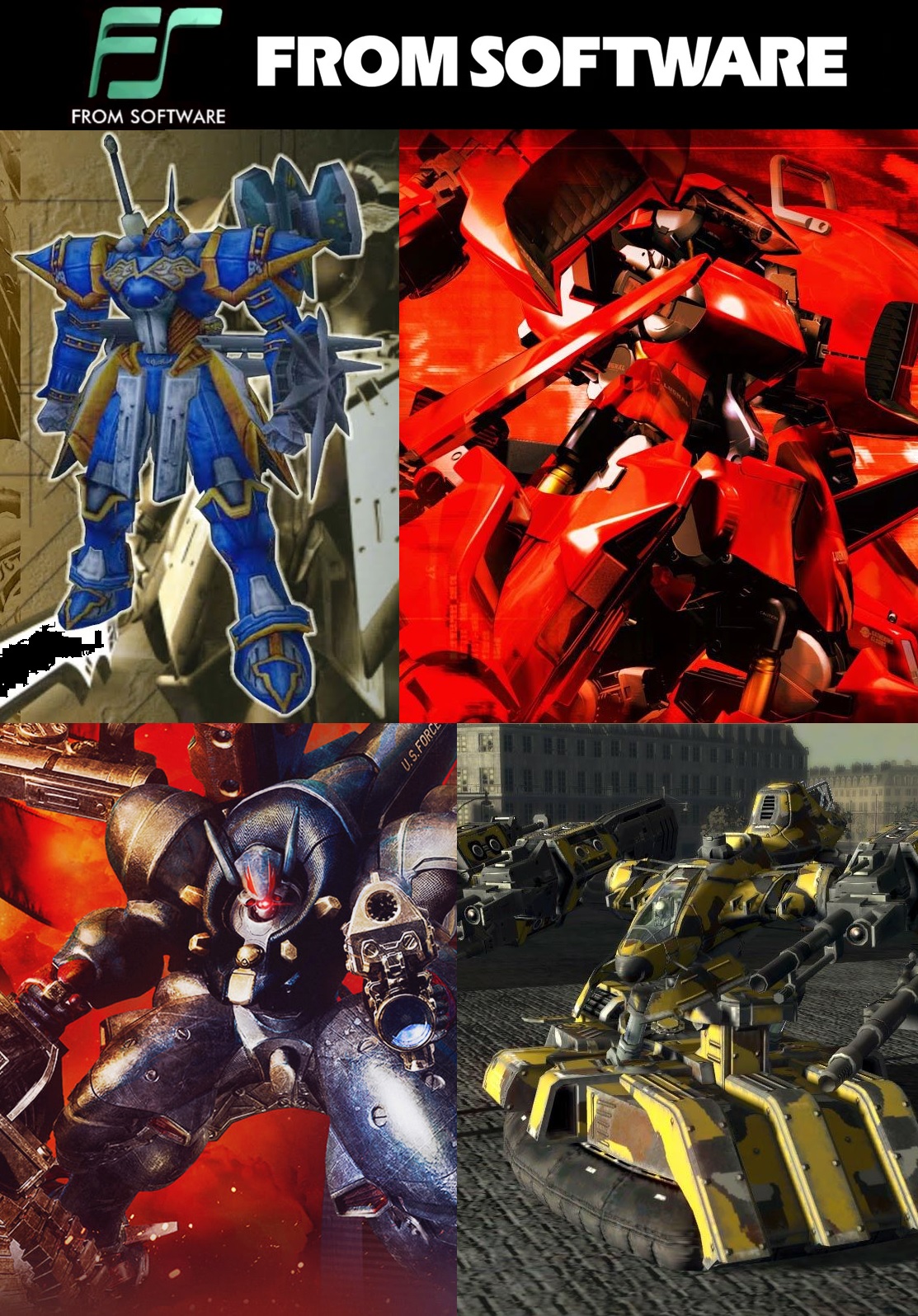
Which one of these got an actual model kit?
Hint: Not the one you're likely thinking of!

Prior to Soulsbourne games making FromSoftware synonymous with dark fantasy (though the studio had always been known for that, since its very first game), the studio was actually more known as a studio that specialized in giant robots. In fact, FromSoft was so synonymous with mecha that it would also be hired to develop games based on other companies' IPs, namely Sunrise's Gundam Unicorn, Capcom's Steel Battalion (though the less said about that Kinect-only game, the better), & most notably Banpresto's crossover series Another Century's Episode/A.C.E. (though the less said about the PS3 game, the better). All that being said, though, it wasn't just Armored Core games & licensed IP titles that FromSoftware developed when it came to mecha, as there are four standalone games involving giant robots that came out in Japan between mid-1999 & mid-2006, i.e. Demon's Souls was only just barely starting development by the last one. Two of them (later three) would see international release, but most notably all of them came from different staff within FromSoftware, with very little carryover beyond some producers & music/sound staff member Kota Hoshino (who's still with FromSoft to this very day, but hasn't composed music for games since 2013), showing a remarkable amount of variety in style, tone, & execution within a shared overall concept of "giant robots". So, to mark FromSoftware's return to mecha with the release of Armored Core VI: Fires of Rubicon, let's take a look at what can be best described as the studio's "Un-Armored Cores".